 English
 Español
+86-13777012108
(WhatsApp/WeChat)
Home / News / Industry News / How to Troubleshoot Parking Lot Lights: A Practical Step-by-Step Field Guide
How to Troubleshoot Parking Lot Lights: A Practical Step-by-Step Field Guide
At 6:40 on a Tuesday evening, the call comes in: eight pole lights across the north lot are dark, three more are strobing, and one breaker has tripped twice since the last rainstorm. The instinct is to put a bucket truck under the nearest dark head and start swapping parts. That approach burns labor and often replaces a healthy fixture while the real fault sits in a handhole 200 feet away.
Almost every parking lot lighting problem belongs to one of five groups: a control device that never turned the circuit on, a wiring or grounding fault, a fixture-level failure such as a driver or LED module, a photocell that has drifted or died, or water and corrosion at splices and pole bases. Work from the panel outward, use the symptom pattern to narrow the group, and you will usually know which of the five you are dealing with in about 20 minutes.
Content
- 1 Read the Symptom Pattern Before You Climb
- 2 Why LED Parking Lot Lights Fail Differently Than HID
- 3 A Six-Step Diagnostic Order That Saves Truck Trips
- 4 Fixture-Level Checks Worth Doing on the Ground
- 5 Repair or Replace: Run the Five-Year Numbers
- 6 Matching the Right Fixture to Each Part of the Lot
- 7 Safety and Code Details That Get Skipped
Read the Symptom Pattern Before You Climb
One dark pole and one dark circuit are different problems. The pattern of failures, when they happen, and what the breaker does, narrows the cause faster than any meter reading taken at the top of a pole. Start with the table below, then confirm with measurements.
| Symptom | Most likely cause | First test |
|---|---|---|
| Whole circuit dead, breaker stays closed | Contactor, time clock, or photocell never energized the run | Measure line voltage at the contactor output |
| Breaker trips the instant it is closed | Phase-to-ground or phase-to-phase short in the run | Insulation resistance test from each conductor to ground |
| Breaker trips only after rain or irrigation | Water in a handhole splice or standing in a pole base | Insulation test on wet cable, then open the handholes |
| One pole dark, the rest of the run fine | Driver failure, in-pole fuse, or a shorted photocell on that head | Check voltage at the fixture leads with the circuit live |
| Heads cycle on and off all night | Failing photocell or low voltage at the far end of the run | Log voltage at the last pole through a full evening |
| Half a run dark, half still lit | Damaged cable between two poles or an open shared neutral | Split the circuit at the midpoint and retest |
Why LED Parking Lot Lights Fail Differently Than HID
Parking lot circuits were sized for high-intensity discharge loads. A 400 W metal halide fixture with its ballast drew roughly 4 A at 120 V. Replace it with a 150 W LED and the current falls to about 1.25 A, so the existing wire should have an easier life. In practice, LED retrofits expose two problems the old fixtures hid.
First, LEDs behave differently at low voltage. A metal halide lamp at the end of a long, undersized run simply dims and warms up slowly. An LED driver has a hard input range, often 100 to 277 V, and it will drop out, restart, or protect itself once the voltage sags below that floor. A single-phase 120 V circuit feeding eight 150 W fixtures 400 feet from the panel pushes about 10 A through roughly 800 feet of 12 AWG copper. At 1.93 ohms per 1000 feet that is about 1.5 ohms of conductor and roughly 15 V of drop, close to 13 percent. The last head sees about 105 V, which is enough to make some drivers flicker and others fail early.
Second, cold-start inrush. LED drivers can pull tens of amps for a few hundred microseconds when they energize. Twenty of them starting at the same instant on one 20 A breaker will nuisance trip a breaker with a fast instantaneous curve, even though the steady-state load is light. Splitting the run into two circuits or staggering start times through a multi-pole contactor solves more nuisance trips than a larger breaker ever will.
A Six-Step Diagnostic Order That Saves Truck Trips
Work in this sequence and stop as soon as one step isolates the fault.
- Confirm the feed. Measure line to line and line to neutral at the panel and at the first pole. A reading within 3 percent of nominal tells you the utility side is not the problem.
- Confirm the control path. Jump the time clock or contactor coil and watch for the contactor to pull in. If the lights come on when you bypass the control, the fault lives in the control, the photocell, or the low-voltage wiring that feeds them.
- Measure the far end with the lights running. More than 5 percent drop at the last pole is a warning, and more than 10 percent calls for conductor work or splitting the run.
- Split the circuit in half. Open the splice at the midpoint and retest. If the fault disappears, it lives in the half you disconnected. If it stays, it is in the half still connected. Repeat until one span remains.
- Bench-test the suspect fixture. Feed it from a known-good circuit on the ground before anyone goes up. A driver that runs fine on the bench was never the problem.
- Inspect handholes and pole bases last, but do not skip them. Standing water, discolored splices, loose lugs, and heat damage explain most intermittent faults that appear only after rain.
Fixture-Level Checks Worth Doing on the Ground
Drivers and LED Modules
Drivers are the most common field failure in LED parking lot lighting. A driver that fails open turns the head dark. A driver that fails partially gives you flicker, strobing, or half brightness. Check the label for input range and rated output current, and look for a burnt smell or discolored potting compound. If a driver is rated 100 to 277 V and the circuit sags to 104 V, the fixture may work in cool weather and drop out in summer when voltage falls further.
Photocells and Control Devices
Photocells drift and fail after five to seven years outdoors. A head that comes on at 4 in the afternoon, or that cycles every few minutes, points to the photocell rather than the fixture. Match the pin configuration, three pin, five pin, or seven pin, and match the voltage. A shorted photocell on a single head can still take down the whole branch circuit, so do not dismiss it as a one-lamp problem.
Water Ingress and Gaskets
Parking lots are the harshest environment most outdoor fixtures ever see: rain, salt spray from winter treatment, exhaust film, and wide day-to-night temperature swings. Housings rated IP65 or IP66 depend on intact gaskets and correctly torqued fasteners. One cracked lens gasket or a missing breather plug lets moisture in, and condensation on the inside of the lens is the first visible sign. Corrosion on the driver board follows within a season.
Repair or Replace: Run the Five-Year Numbers
Do the math on truck time, not on parts. A replacement driver costs a fraction of a new fixture, but if the fixture is 30 feet in the air you pay the mobilization twice, once to diagnose and once to swap. A workable rule is to repair when the fixture is under five years old, the housing is sound, and a single component has failed. Replace when the same head has failed twice in three years, when lenses are yellowed and output has visibly dropped, or when housings are corroded at the mounting arm.
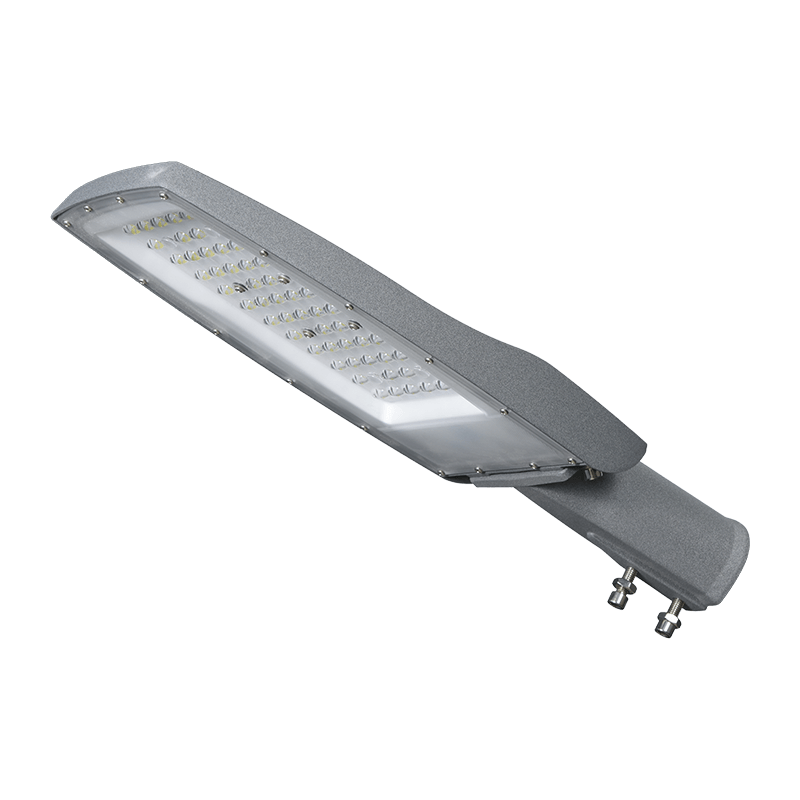
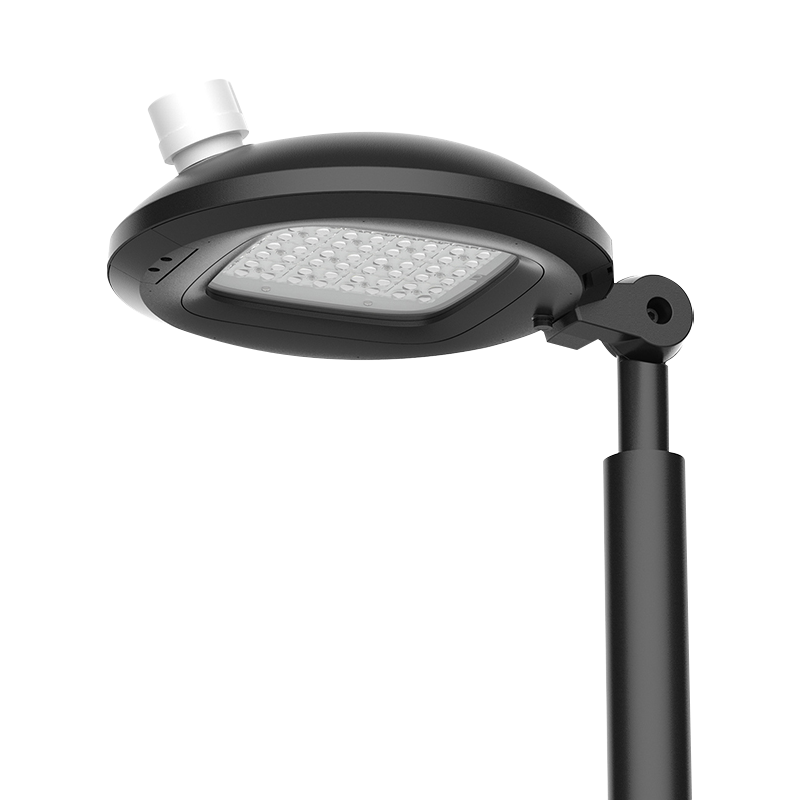
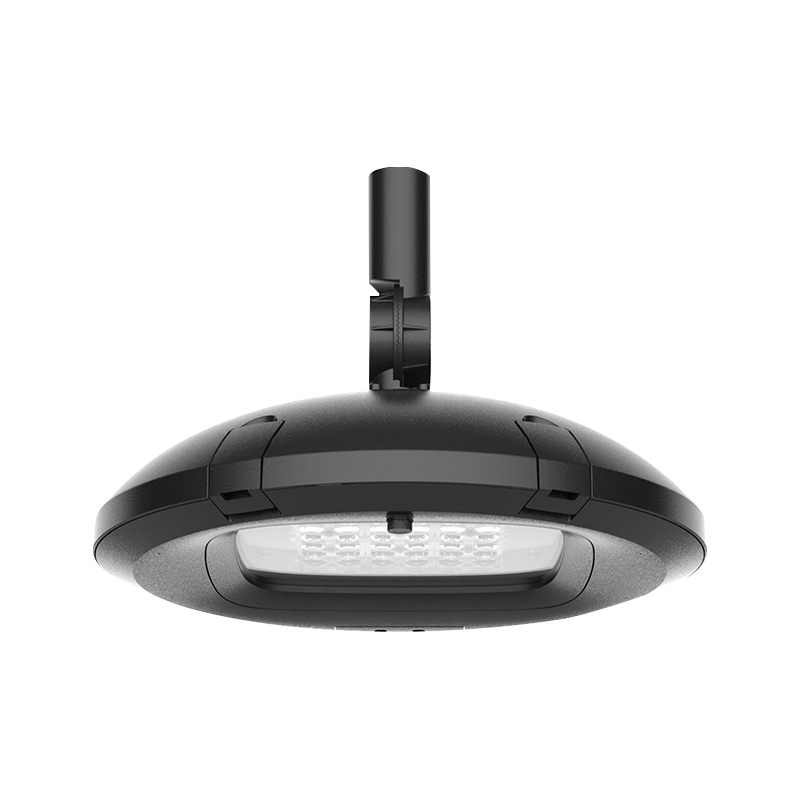
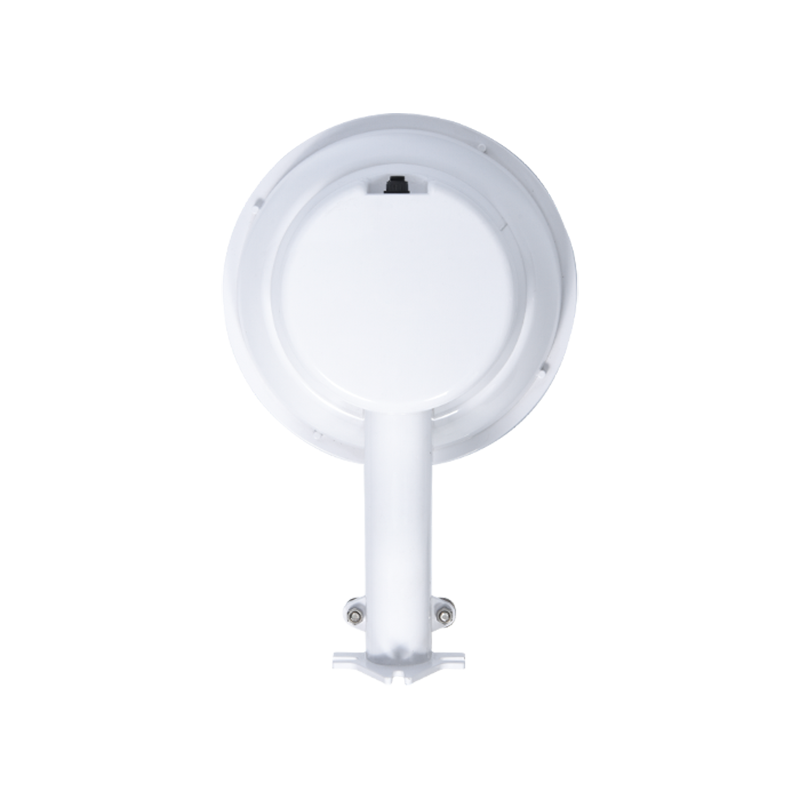
Standardizing on one or two models cuts spare-parts inventory and simplifies what you keep on the shelf. For pole-mounted lot lighting, a 150 W LED street light with a Type II or Type III distribution pattern replaces a 250 W to 400 W HID head on a 25 to 30 foot pole and keeps the existing pole and wiring in service.
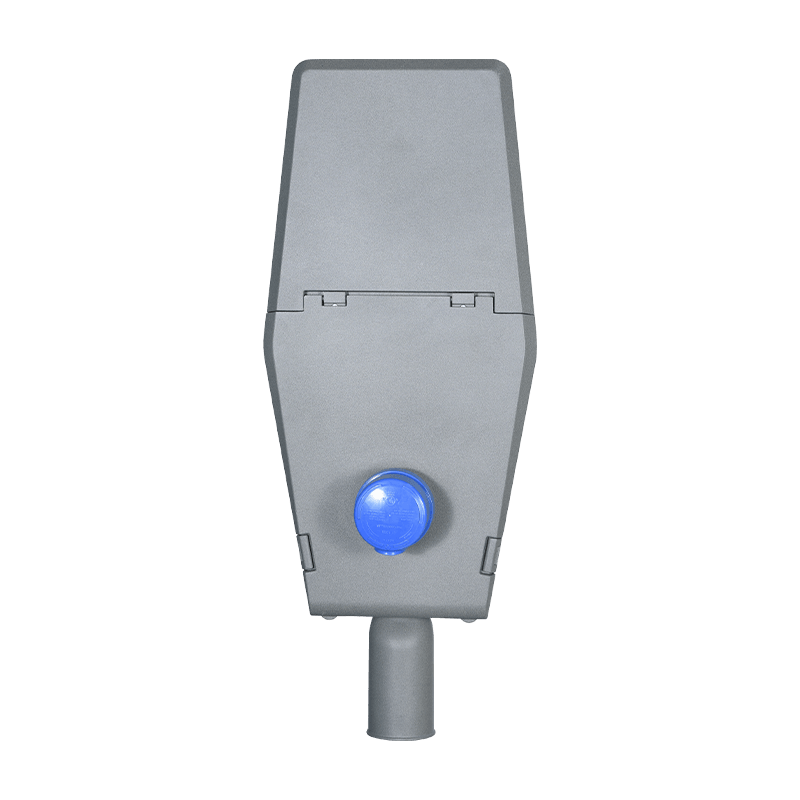 PY-LED666 150W LED Street Light for Pole-Mounted Lot Lighting150 W LED streetlight with Type II/III optics and IP66 construction, suited for pole-mounted lot lighting where 250–400 W HID heads are being replaced.View Product →
Matching the Right Fixture to Each Part of the Lot
Pole-Mounted Rows and Perimeter Area Lighting
For the open rows in the middle of a lot, a street light with the correct distribution is the right tool. For perimeter runs, loading zones, or lots where pole spacing is wider than the photometric layout wants, a flood fixture aimed across the surface often solves shadowing a street light cannot reach. Beam pattern matters more than wattage: a narrow flood aimed at one corner wastes light, while a wide beam at the wrong mounting height throws light onto neighboring property. If the difference between the two is not yet clear, this guide on what a floodlight actually is covers beam shapes, mounting heights, and aiming.
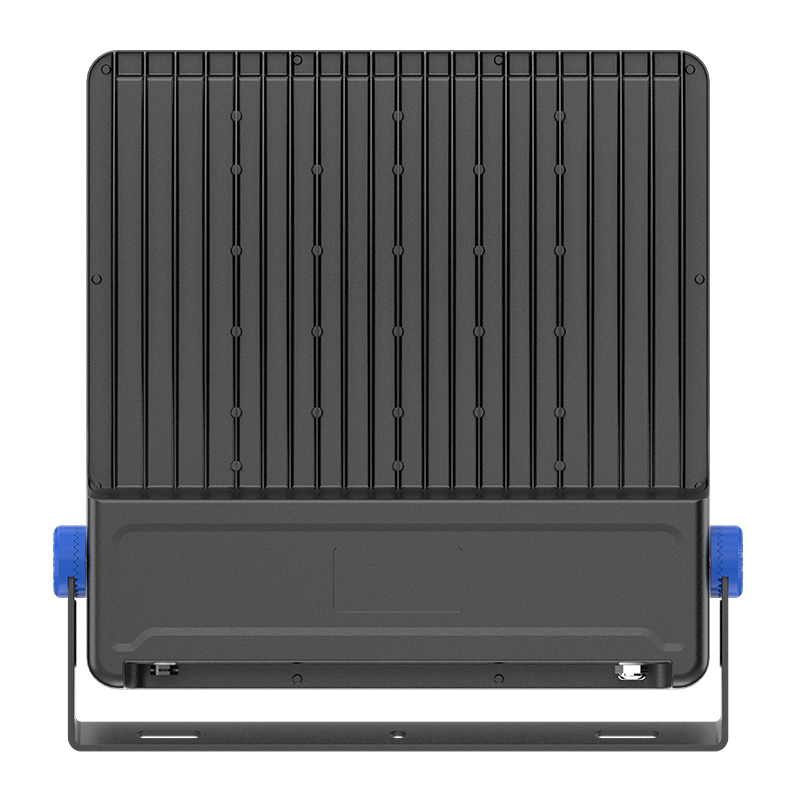 PY-FL05 300W LED Flood Light for Large Outdoor Spaces300 W floodlight with IP67 die-cast aluminum housing and CRI 80+ output, useful for perimeter or loading-area lighting where pole spacing leaves shadows.View Product →
Walls, Walkways, and Building Faces
Not every part of a lot is lit from a pole. Wall packs cover building perimeters, dumpster pads, and the path between parked cars and an entrance door. On a parking structure they also give you a second lighting layer if the pole circuit is ever down for repairs. Look for a die-cast aluminum housing, a gasketed lens, and a photocell option so the fixtures behave consistently with the rest of the site.
 PY-WP9004 Outdoor Waterproof Wall Pack LightIP65 aluminum wall pack for courtyards, balconies, hallways, and garages, providing a sealed, weather-resistant lighting layer along building perimeters.View Product →
Safety and Code Details That Get Skipped
Lock out and tag the circuit before opening a handhole, and treat every parking lot circuit as live until you have proved it dead at the point of work. In North America, 120 V single-phase 15 A and 20 A outdoor receptacles in parking areas require ground fault protection, and that rule catches a surprising number of lot circuits that were never updated. Use listed splicing methods inside handholes rated for direct burial, keep conductors off the bottom where water collects, and torque lugs to the value printed on the fixture label. A loose neutral on a shared circuit is one of the few faults that can damage every LED driver on the run at once.
Most parking lot lighting failures are not mysteries. A symptom pattern, three voltage readings, and one half-circuit split will tell you whether you are chasing a control, a conductor, or a fixture. Fix the cause before you replace the head, and keep a written record of which poles failed and when, because the second failure on the same pole tells you far more than the first one did. If you are building a replacement schedule and want fixtures matched to your pole spacing and circuit layout, you can send the details through the contact page and get a fixture schedule back.
Previous Post
Industrial Outdoor Lighting Fixtures: Specs That Decide Project Outcomes
Next Post
How Much Are Stadium Lights? Real Project Costs, Wattage and Buying Guide
Related Products

Our Products
Keep In Touch
export@polaryang.cn
+86-574-65167530
Xue'ao Qiangjiao Town, Ninghai County, Ningbo, Zhejiang, China
Contact Us
Copyright © Ninghai Poda Electrical Appliance Co., Ltd. Rights Reserved.
Wholesale LED Lighting Manufacturer
OEM Solar Lighting Factory
