 English
 Español
+86-13777012108
(WhatsApp/WeChat)
What are the advantages of LED garden lights?
LED garden lights outperform traditional outdoor lighting on every meaningful dimension: energy efficiency, lifespan, environmental safety, weather resistance, and light quality. Compared to incandescent or halogen garden lights, LED fixtures consume up to 80% less electricity while lasting 25,000 to 50,000 hours — far exceeding the 1,000–2,000 hour lifespan of conventional bulbs. They contain no mercury or lead, operate reliably in rain and freezing temperatures, and offer flexible control options that traditional technologies cannot match.
Content
Outstanding Energy Efficiency
Energy savings are the most immediately quantifiable advantage of LED garden lights. LEDs convert approximately 90% of electrical energy into light, compared to just 10–15% for incandescent bulbs (which waste the remainder as heat). In practical terms, a 10W LED garden light delivers the same illumination as a 60W halogen equivalent — a direct 83% reduction in power consumption.
For a garden path installation with 10 lights running 8 hours per night, switching from 60W halogen to 10W LED saves roughly 1,460 kWh per year — a meaningful reduction in both energy bills and carbon footprint.
Exceptional Lifespan and Durability
LED garden lights are rated for 25,000 to 50,000 hours of continuous use — equivalent to over 17 years at 8 hours per night. This dramatically reduces the frequency of bulb replacements compared to fluorescent (8,000–10,000 hours) or incandescent (1,000–2,000 hours) alternatives.
Beyond the LED component itself, quality LED garden lights are built with high-grade materials that ensure structural durability and corrosion resistance in harsh outdoor environments — including salt air, UV radiation, and temperature cycling from -30°C to +50°C. Under normal conditions, LED garden fixtures maintain stable luminous output with negligible failure rates throughout their rated service life.
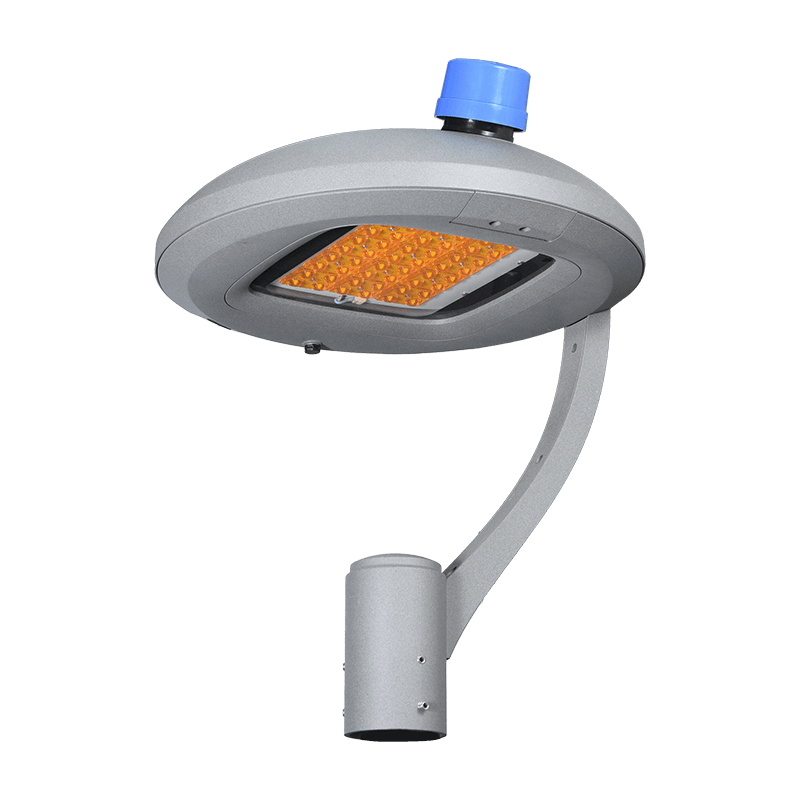
Waterproof and Dustproof Performance
Adaptability to outdoor environments is one of the defining technical strengths of LED garden lights. Using specialized sealing materials and engineered structural design, LED garden fixtures effectively prevent moisture and dust from entering the lamp housing — ensuring reliable operation across all weather conditions.
The protection level is rated using the internationally standardized IP (Ingress Protection) code. For garden lighting, the minimum recommended rating is IP65 (dust-tight and protected against water jets from any direction), while fixtures in wet environments such as pond edges or fountain surrounds should carry at least IP67 or IP68 (submersion-rated).
IP Rating Guide for Garden Lighting
| IP Rating | Protection Level | Suitable Application |
|---|---|---|
| IP44 | Splash-proof | Covered patios, pergolas |
| IP65 | Dust-tight, jet water resistant | Path lights, bollards, wall fixtures |
| IP67 | Dust-tight, immersion to 1m | In-ground uplights, near water features |
| IP68 | Continuous submersion rated | Underwater pond and pool lights |
Environmental Safety: No Toxic Materials
LED garden lights contain no mercury, lead, or other hazardous substances — a significant environmental advantage over fluorescent and older discharge lamps that require specialist disposal as hazardous waste. Throughout the full lifecycle of an LED fixture — production, use, and eventual disposal — environmental pollution is minimized. This aligns with RoHS (Restriction of Hazardous Substances) and WEEE (Waste Electrical and Electronic Equipment) compliance standards increasingly required in global markets.
Superior Light Quality and Controllability
LED technology offers precise control over light characteristics that traditional outdoor lighting cannot match:
- Color temperature flexibility: available from warm white (2700K, ideal for ambient garden atmosphere) through to cool white (6500K, suited for security and task lighting)
- Instant full brightness: no warm-up time required, unlike metal halide or sodium vapor lamps that take several minutes to reach full output
- Dimmability: LED garden lights are compatible with dimmer controls and smart home systems, allowing output adjustment from 0–100% without flicker or color shift
- Directional output: LEDs emit light in a focused direction, reducing wasted light scatter and light pollution compared to omnidirectional incandescent sources
- Motion sensor and timer compatibility: easily integrated with occupancy sensors and programmable timers for automated, energy-saving garden lighting schedules
LED vs. Traditional Garden Lights: Summary Comparison
| Feature | LED Garden Light | Halogen / Incandescent | Compact Fluorescent (CFL) |
|---|---|---|---|
| Lifespan | 25,000–50,000 hrs | 1,000–2,000 hrs | 8,000–10,000 hrs |
| Energy use (equivalent output) | 10W | 60W | 15W |
| Contains mercury | No | No | Yes |
| Instant full brightness | Yes | Yes | No (warm-up needed) |
| Cold weather performance | Excellent | Good | Reduced output |
| Dimmable | Yes | Yes | Limited |
Previous Post
What is the lifespan of an LED high bay light?
Next Post
How long is the lifespan of an LED Flood Light?
Related Products

Our Products
Keep In Touch
export@polaryang.cn
+86-574-65167530
Xue'ao Qiangjiao Town, Ninghai County, Ningbo, Zhejiang, China
Contact Us
Copyright © Ninghai Poda Electrical Appliance Co., Ltd. Rights Reserved.
Wholesale LED Lighting Manufacturer
OEM Solar Lighting Factory
