 English
 Español
+86-13777012108
(WhatsApp/WeChat)
Home / News / Industry News / Softball Field Lighting Guide: Light Levels, Pole Layout, and LED Selection
Softball Field Lighting Guide: Light Levels, Pole Layout, and LED Selection
A community softball field at dusk often shows the same pattern: the infield is bright near the poles, the outfield corners fall into shadow, and the pitcher briefly loses the ball against a dark background. The cause is rarely one weak fixture. It is usually a layout that was not planned around the playing surface. For most night-play and league-level fields, plan for 30 to 50 foot-candles on the infield, at least 20 to 30 foot-candles in the outfield, and uniformity and glare control that keep the ball visible from the batter's box to the deepest catch.
That conclusion leads directly to the practical work: set the light level and uniformity targets, study pole positions and aiming angles, then choose LED floodlights and controls that can deliver those targets after installation. Buying fixtures first often produces a field that looks bright in a sales brochure but feels uneven when a fly ball crosses the foul line.
Content
- 1 Set light levels and uniformity before shopping
- 2 What makes softball lighting different from baseball
- 3 Pole layout and fixture aiming
- 4 LED floodlights for softball fields
- 5 Controls, commissioning, and maintenance
- 6 Procurement checklist for softball field lighting
- 7 A practical rule for softball field lighting
Set light levels and uniformity before shopping
Average light level is only one number. A field that averages 40 foot-candles but drops to 8 foot-candles near foul territory feels darker than its average suggests. Ask for a photometric plan that shows horizontal illuminance across the infield, outfield, dugouts, and runways, plus vertical illuminance where players track high fly balls and line drives.
| Use case | Infield target | Outfield target | What matters most |
|---|---|---|---|
| Community and youth play | 20 to 30 foot-candles | 15 to 20 foot-candles | Safe footing, visible catches, and controlled spill light |
| High school and college play | 40 to 50 foot-candles | 25 to 30 foot-candles | Vertical light for infielders and low glare for batters |
| Tournament or broadcast use | 70 to 100 foot-candles | 50 to 70 foot-candles | Camera performance, flicker control, and color consistency |
Uniformity is usually expressed as minimum divided by average. A tighter ratio reduces dark pockets that force players to guess. Color temperature also matters. Most softball fields sit comfortably between 4000 K and 5700 K, with a color rendering index high enough to separate an optic yellow ball from grass, dirt, and shadows. For broadcast or recorded play, confirm flicker-free drivers and consistent color from fixture to fixture.
What makes softball lighting different from baseball
Softball fields are smaller than baseball fields, but the visual task is not automatically easier. Infielders play closer to the batter, the ball can rise quickly through the infield background, and the batter looks up into the pole line. A bright bare LED that shines into the batter's eyes can wash out the release point even when the field average is high. That is why glare control and vertical illuminance deserve as much attention as horizontal foot-candles.
The outfield also needs a deliberate plan. A 200 to 225 foot fence line can place fielders near the edge of the light pattern. If the poles are aimed only at the infield, the outfielders may track a fly ball into a dim background. Good designs balance infield and outfield light while keeping spill light away from nearby homes, roads, and dugouts.
Pole layout and fixture aiming
Pole layout determines whether the fixtures can deliver even light without creating a glare problem. A four-pole layout can work for community fields when poles are placed beyond the foul lines and outfield, but a six-pole layout usually spreads light more evenly for higher-level play. Pole height commonly falls in the 40 to 70 foot range depending on field geometry, class of play, and the photometric plan.
- Keep poles out of play and away from dugouts, warm-up areas, and player sight lines.
- Aim fixtures across the field rather than straight down to improve vertical light and reduce harsh shadows.
- Use an aiming chart with coordinates so the contractor can set each fixture to the design angle.
- Check spill light at the property line and at nearby seating or parking areas before approving the layout.
- Leave room for future controls, spare circuits, and safe maintenance access.
A photometric plan should show the field with the actual fixture, lumen output, mounting height, tilt, and aiming direction. If the plan uses generic floodlights or omits aiming angles, the installed result may not match the promised light level.
LED floodlights for softball fields
LED floodlights are common for softball fields because they start instantly, accept precise optics, and can be dimmed or scheduled. The right choice depends on delivered lumens and beam control at the field, not wattage alone. A 500W LED floodlight can be a practical reference point for community and school fields when the photometric plan calls for that output class and the pole layout supports it.
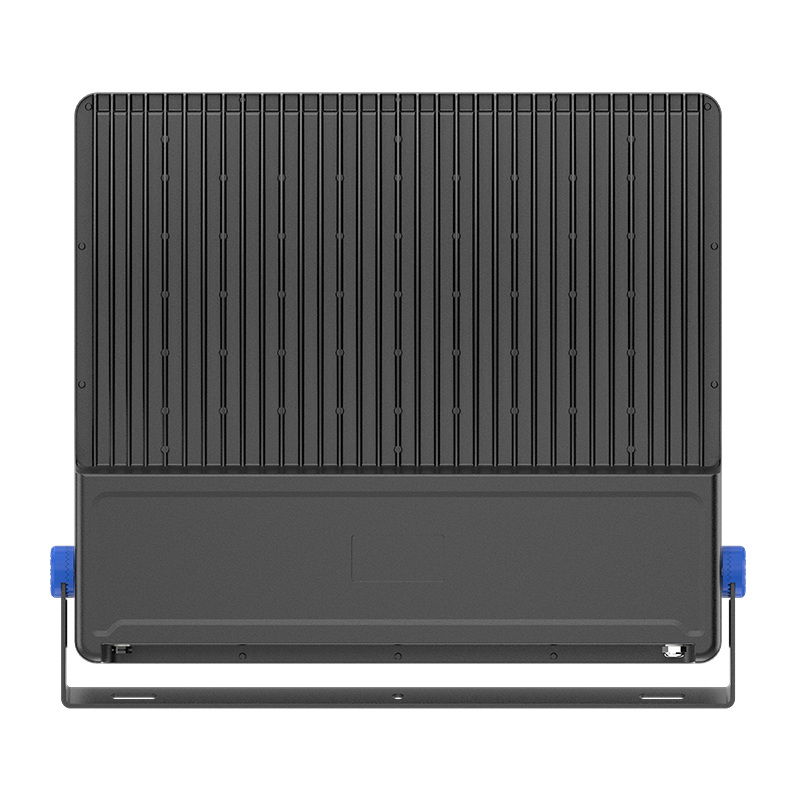 PY-FL05-500W Environmental LED Flood LightA 500W LED floodlight with mercury- and lead-free design and high energy savings, useful as a reference output class for community and school fields.View Product →
For larger facilities or layouts with fewer poles, a 600W model can help meet higher targets while reducing the fixture count. That trade-off needs to be checked against pole loading, wind load, glare, and maintenance access. More output in the wrong beam pattern can create brighter hot spots without improving player visibility.
 PY-SP08-600W High-Output LED Flood LightA 600W LED floodlight with high-output chips, natural color rendering, and IP65 weather resistance, suited to stadiums and outdoor areas where fewer fixtures are preferred.View Product →
Look for aluminum housings, corrosion-resistant finishes, sealed optics, and drivers that match the local power quality. For outdoor fields, ingress protection and surge protection are not small details. They decide whether the lighting system still performs after a season of rain, dust, and lightning activity.
Controls, commissioning, and maintenance
Controls can turn a good field lighting design into a manageable asset. Manual contactors are acceptable for small fields, but scheduled dimming, zone control, and remote monitoring help larger facilities reduce energy use and diagnose faults. A common approach is to run lower light levels for practice and full output for games, with separate switching for infield, outfield, and spectator areas.
Commissioning is where the design meets reality. After installation, the contractor should aim fixtures to the photometric plan, measure light levels at night, and adjust any hot spots or dark pockets. Ask for a signed aiming report and a measurement record. Before finalizing a design, review these stadium lighting selection considerations so the fixture schedule, controls, and warranty terms align with the field's actual use.
Maintenance access also affects lifecycle cost. Fixtures that are difficult to reach may stay out of aim for seasons. Specify accessible mounting, clear spare parts availability, and a warranty that covers drivers and housings. A lighting system is a long-term field asset, not a one-night purchase.
Procurement checklist for softball field lighting
Requests for quotation should be specific enough to compare suppliers fairly. Ask for the following with every bid:
- Photometric plan with foot-candle values, uniformity, and glare calculations.
- LM-79 and LM-80 reports, IES files, and driver specifications.
- IP rating, corrosion protection, surge protection, and operating temperature range.
- Pole loading calculations and wind load data for the project location.
- Control options, dimming range, and compatibility with the planned scheduling method.
- Warranty terms, spare parts lead time, and installation support.
Compare bids on delivered performance, not only fixture price. A lower-cost package that needs more poles, more cabling, or a second aiming visit can cost more over the life of the field.
A practical rule for softball field lighting
Start with the playing surface, set the light level and uniformity targets, and design the pole layout before choosing fixtures. Then select LED floodlights, controls, and maintenance access that can meet those targets after commissioning. If you are planning a field, contact our team with the field dimensions, class of play, pole locations, and preferred light levels so the layout and fixture selection can be reviewed together.
Previous Post
Security Lighting Solutions: How to Specify Coverage, Controls, and Fixtures
Next Post
Pickleball Court Lighting Requirements: Lux Levels, Uniformity and Pole Height
Related Products

Our Products
Keep In Touch
export@polaryang.cn
+86-574-65167530
Xue'ao Qiangjiao Town, Ninghai County, Ningbo, Zhejiang, China
Contact Us
Copyright © Ninghai Poda Electrical Appliance Co., Ltd. Rights Reserved.
Wholesale LED Lighting Manufacturer
OEM Solar Lighting Factory
