 English
 Español
+86-13777012108
(WhatsApp/WeChat)
Home / News / Industry News / Pickleball Court Lighting Requirements: Lux Levels, Uniformity and Pole Height
Pickleball Court Lighting Requirements: Lux Levels, Uniformity and Pole Height
A club installs four 300 W floodlights on 18 ft poles, the meter reads 250 lux at center court, and players still lose the ball against a bright evening sky. Nothing in the numbers was wrong. The problem was glare, uniformity and aiming, which are three separate requirements from raw brightness.
For practical purposes, pickleball court lighting requirements come down to five measurable targets: maintained average illuminance for the level of play, uniformity across the whole playing surface, glare control inside the player sightline, spill light at the property boundary, and an enclosure that survives the local weather. Get those five right and the court plays well for a decade. Miss any one of them and the failure is obvious within a week of the first night session.
The sections below give working figures for each target, then explain how pole height, optics and fixture rating change the outcome.
Content
Light Levels by Level of Play
The first requirement is average maintained illuminance, not the wattage printed on the box. A 200 W and a 400 W fitting can produce the same lux at court level if the optics differ, so the specification should always be written in lux or footcandles on the playing surface and then converted back into lumens and beam angles by a photometric study.
| Level of play | Average maintained illuminance | Max to min uniformity | Typical color temperature |
|---|---|---|---|
| Recreational, backyard, school | 200 to 300 lux (about 19 to 28 fc) | 3:1 or better | 4000 K to 5000 K |
| Club, league, paid sessions | 400 to 500 lux (about 37 to 46 fc) | 2:1 or better | 5000 K |
| Tournament and show court | 750 lux and above | 1.5:1 or better | 5000 K |
Two details trip people up here. First, maintained values already allow for dirt on the lens and normal lumen depreciation, so the design figure must be calculated at end of life rather than at day one. Second, higher output is not automatically better: an over-lit recreational court creates harder shadows and pushes spill light onto neighbouring properties, which is a compliance problem rather than a comfort problem.
Uniformity Decides How the Court Feels
A court averaging 400 lux at a 4:1 max to min ratio will feel worse to players than a court averaging 300 lux at 2:1. Bright and dark patches force the eye to re-adapt each time the ball crosses the court, and the effect grows as the ball rises above the sightline into a darker background.
The practical rule is simple: keep the darkest grid point within one third of the brightest for league play, and within half for tournament play. Uniformity is achieved with four poles rather than two, wider beam distributions, and a deliberate overlap between fixtures. Aiming every luminaire at the court center is the most common mistake, because it produces a hot spot in the middle and dim corners near the baselines where the ball is most often played.
Glare Control and the Player Sightline
Pickleball is played with a low net and frequent lobs, so players spend a lot of time looking upward. That makes glare control a hard requirement, not a refinement. Any luminaire whose emitting surface falls inside the cone a player sees when tracking a lob is a design fault, even if it is 25 ft in the air.
Three measures fix this in most layouts. Use asymmetric or shielded optics with flat glass instead of open reflectors. Place poles outside the run-back area so no fixture sits directly behind a baseline. Set the aiming angle so the fixture body shields the light source from the far side of the court. Where a site is tight and poles must be close to the court, choose a distribution that throws light across the court rather than straight down into the play area.
Pole Height, Placement and Spill Light
Mounting height determines how far a fixture must throw and how steep the angle of incidence is. For a single court, 20 to 24 ft is common. For a multi-court complex, 25 to 30 ft allows fewer poles and better uniformity, at the cost of heavier structures and more careful aiming. Anything below 18 ft tends to put the light source close to eye level on high shots.
Position poles two to three ft outside the sideline or baseline, inside the recommended total footprint of roughly 60 ft by 30 ft for a fenced court. Spill light is then limited with backlight shields, internal louvers or a tighter vertical beam angle, which keeps the neighbour-facing side of the pole dark. For larger installations, the same design logic used for large-area sports lighting applies: measure the spill at the boundary line before ordering poles, because shielding added afterwards rarely looks the same.
Enclosure, Corrosion and Electrical Requirements
Weather and salt exposure
Outdoor courts need at least IP65, and IP66 where wind-driven rain or washdown is expected. Coastal and roadside sites should specify die-cast aluminum housings with powder coating and stainless fasteners, sized for a corrosion category that matches the location. Coating damage in the first year is usually a pretreatment issue rather than a paint choice, so ask for the coating process, not just the color.
Color and rendering
5000 K with a color rendering index of 70 or higher is the working standard for outdoor pickleball. Cooler light improves contrast between the ball and the background while keeping the scene from looking harsh, and a higher CRI helps players judge depth on fast volleys. Avoid mixing color temperatures on one court; a single warm fixture in a row of cool ones is immediately visible.
Electrical protection
Ask for a surge protection rating of 10 kV or higher per driver, a power factor above 0.9, and a driver rated for the local ambient temperature rather than for a laboratory. On a pole-mounted installation, driver failure is almost always thermal or surge related, and both are preventable at the specification stage.
Matching the Fixture to the Layout
A single court with two poles on the long axis is usually served by a compact asymmetric street-style luminaire aimed across the court rather than along it. This keeps the light source out of the baseline sightline and holds uniformity without adding fixtures.
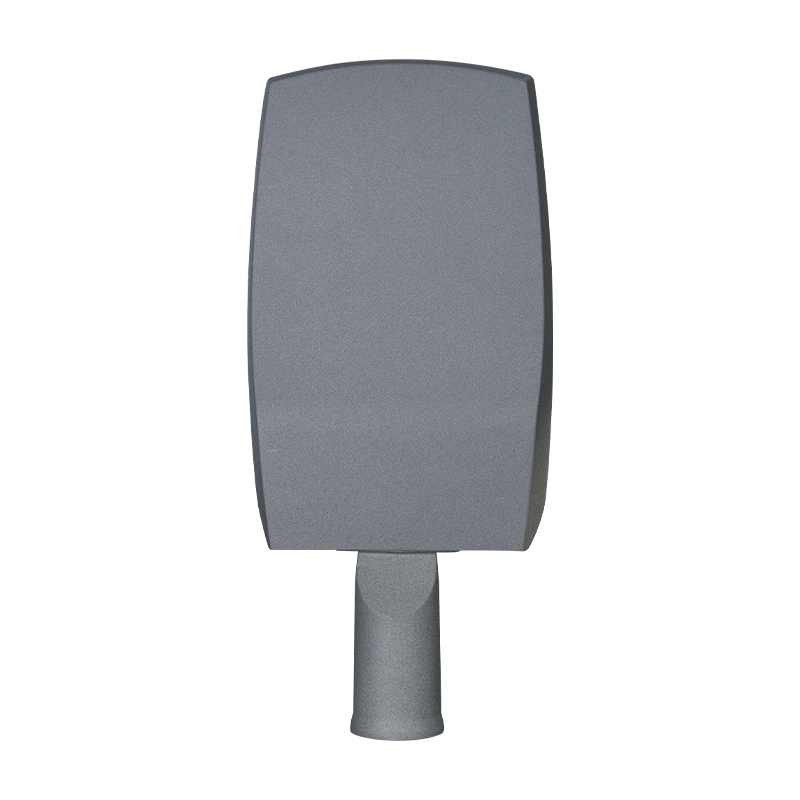 120W LED Stadium and Street LuminaireA 120W modular fixture for court and field lighting, using precision optics and die-cast aluminum to support uniform coverage and simpler maintenance.View Product →
Two-court and four-court layouts need more raw output and a wider throw. High-output floodlights on 25 to 30 ft poles, aimed to overlap at the mid-court line, deliver the 400 to 500 lux band without stacking fittings on the same position.
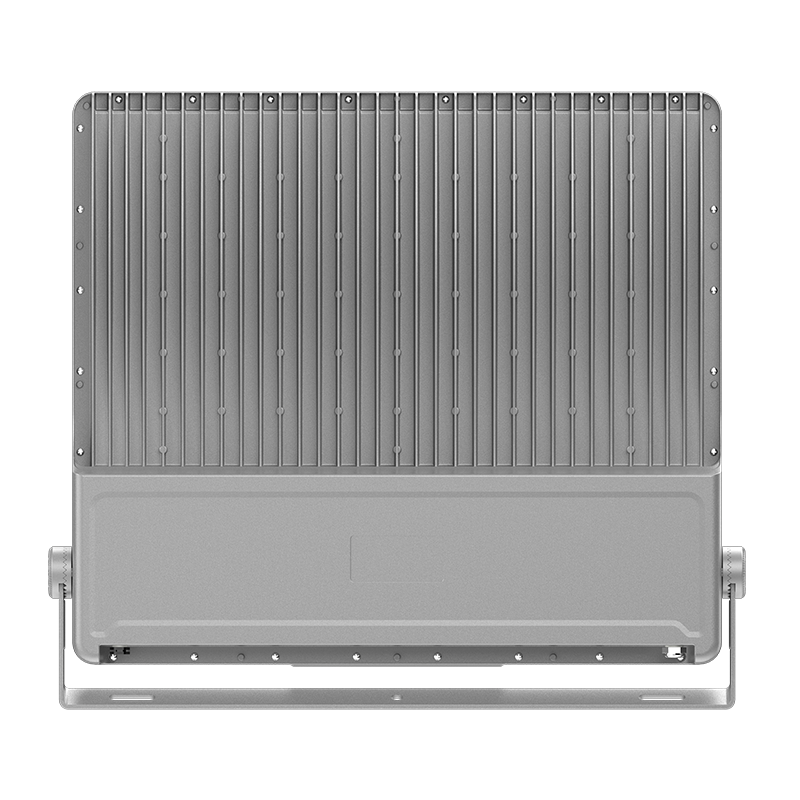 500W High-Output LED Flood Light for Large AreasDelivers over 65,000 lumens with a die-cast aluminum, IP67 housing for stadiums, ports and plazas where wide, high-intensity illumination is needed.View Product →
Where the site is close to salt water or a busy road, the housing specification becomes the deciding factor. Look for a corrosion-resistant die-cast body and a sealed driver compartment, and confirm the lens gasket is replaceable, because a sealed optical chamber that cannot be serviced usually ends up being replaced entirely.
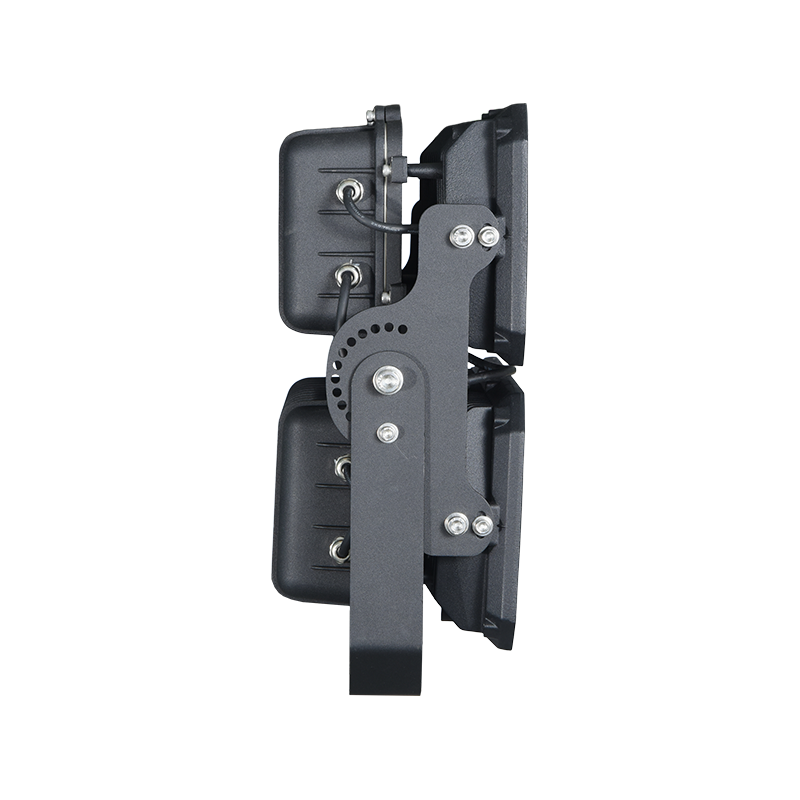 480W Corrosion-Resistant LED Flood Light for Coastal SitesBuilt for high-humidity and salt-fog environments, this 480W fixture offers broad coverage and a sealed, corrosion-resistant design for industrial and outdoor use.View Product →
Controls and Running Cost
Dimming is worth specifying even if the club expects to run at full output. Most pickleball courts see uneven use, and a 50 percent dim level for casual evening play extends driver life and cuts energy noticeably across a season. A photocell plus a time schedule covers the two most common failures: lights left on after dawn and lights switched on before they are needed.
For multi-court sites, split the control into zones so a single booked court does not require lighting the whole complex. The extra cost is small compared with running eight poles for one session.
A Pre-Order Checklist
- Define the level of play and the resulting average lux, then convert to lumens per fixture using the photometric file.
- Set a uniformity limit and confirm the layout meets it at end of life, not at installation.
- Confirm pole height, setback and the total fenced footprint, and check structural wind load for the site.
- Review the aiming plan and verify that no fixture sits inside the lob sightline.
- Calculate spill light at the property boundary and specify shields if margins are thin.
- Match the IP rating, corrosion category and surge protection to the actual location.
- Ask for a maintenance schedule covering lens cleaning and driver inspection intervals.
- Request certifications relevant to the destination market, such as CE or RoHS for European buyers.
Most pickleball lighting disputes trace back to a specification that named wattage instead of illuminance, or a layout that ignored the sightline. Writing the five targets into the tender, and asking every supplier to submit a photometric study against them, removes almost all of that risk before a pole is lifted. If a project needs a fixture selected against a specific court drawing, the team can review the layout and propose the matching configuration.
Previous Post
Softball Field Lighting Guide: Light Levels, Pole Layout, and LED Selection
Next Post
Pickleball Court Lighting Guide: Glare Control, Levels and LED Layout Design
Related Products

Our Products
Keep In Touch
export@polaryang.cn
+86-574-65167530
Xue'ao Qiangjiao Town, Ninghai County, Ningbo, Zhejiang, China
Contact Us
Copyright © Ninghai Poda Electrical Appliance Co., Ltd. Rights Reserved.
Wholesale LED Lighting Manufacturer
OEM Solar Lighting Factory
