 English
 Español
+86-13777012108
(WhatsApp/WeChat)
Home / News / Industry News / Pickleball Court Lighting Guide: Glare Control, Levels and LED Layout Design
Pickleball Court Lighting Guide: Glare Control, Levels and LED Layout Design
A court that looks bright from the parking lot can still leave players losing the ball against the sky. That is the practical problem with pickleball court lighting: brightness alone is not enough. The best result is a controlled system that puts even light on the ball, the lines, and the players while keeping the source out of their eyes.
For a new court or a retrofit, start with the playing experience and work backward to fixtures, poles, and controls. The decisions that matter most are light level, uniformity, glare control, mounting height, color quality, and long-term service access. Wattage comes last, after those choices are clear.
Content
- 1 The Short Answer: Design for Evenness and Glare Control
- 2 Set the Right Light Level for How the Court Is Used
- 3 Why Glare Hurts Pickleball More Than Raw Brightness
- 4 Pole Layout and Mounting Height
- 5 Color Temperature, CRI, and Ball Visibility
- 6 Wattage, Energy, and Product Choice
- 7 Controls, Commissioning, and Purchase Risks
- 8 Solar or No Solar?
- 9 A Practical Buyer Checklist
- 10 Get the Layout Right Before You Buy
The Short Answer: Design for Evenness and Glare Control
Use LED sports or area luminaires with asymmetric optics, neutral or cool white light, and careful aiming. Target a maintained light level that matches the court use, then check uniformity across the entire playing surface. A design that averages well but has hot spots near the net or dark bands along the baselines will feel worse than a slightly lower, more even design.
Do not judge a layout by the fixture count. Two courts with the same total wattage can perform very differently based on beam shape, pole position, tilt, and shielding. The goal is to see the ball early, read its spin, and track it against both the court and the background without visual fatigue.
Set the Right Light Level for How the Court Is Used
Recreational play, club leagues, and tournament use do not need the same lighting. A backyard court can be comfortable at a lower level than a facility that hosts competitive events or video streaming. The table below gives practical starting targets for maintained illuminance on the playing surface. Always confirm the final target with the court owner, insurer, or local sports lighting standard.
| Court use | Typical maintained level | Main design focus | Practical note |
|---|---|---|---|
| Recreational or backyard | 20 to 30 fc | Visual comfort and even coverage | Control glare toward homes and patios |
| Club or league | 30 to 50 fc | No dark baseline bands | Check vertical light for serves and overheads |
| Tournament | 50 to 70 fc | Grid uniformity and controlled spill | Confirm the class with the event organizer |
| Broadcast or video | 70 to 100 fc and above | High vertical illuminance and color consistency | Use a specialist layout and camera test |
At the club level, a 400 W class floodlight can be part of a multi-fixture layout when the optics are correct and the poles are placed to cross-light the court. Do not simply scale up a backyard layout by adding more wattage to the same four corners.
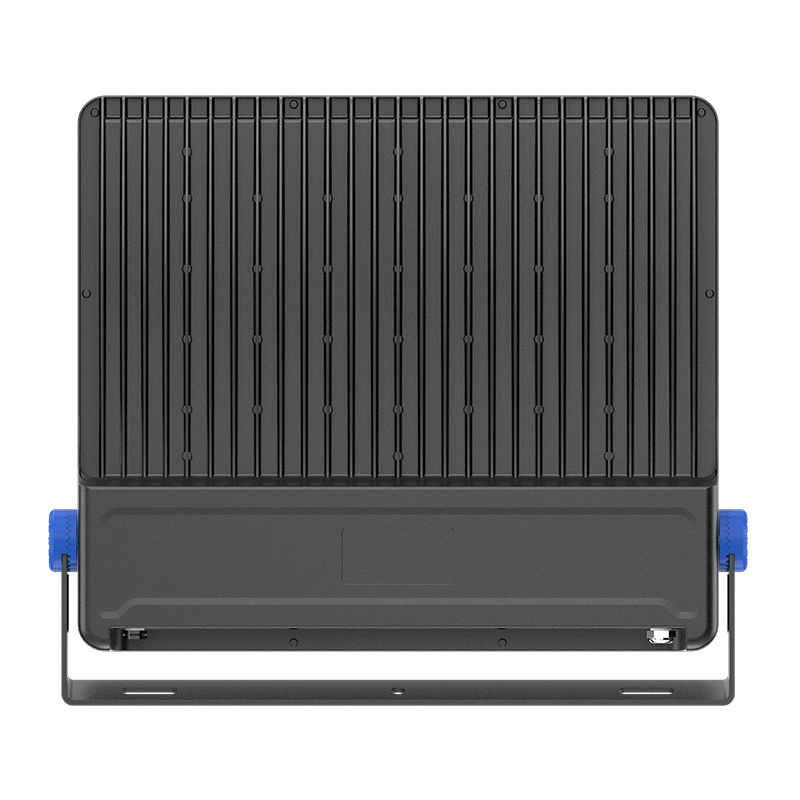 PY-FL05-400W Environmentally Friendly Flood LightA 400 W LED floodlight in the FL05 series with over 95% recyclable materials and modular maintenance access; worth viewing for club-court lighting plans.View Product →
Why Glare Hurts Pickleball More Than Raw Brightness
Pickleball is fast and played in a compact area. Players look up for lobs, overheads, and serves, so an unshielded fixture near the sight line becomes a distraction. Glare also reduces contrast, which makes the ball harder to pick up against the sky or a bright wall.
Three controls matter. First, use asymmetric optics that push light onto the court rather than into the air. Second, mount fixtures high enough and aim them so the light source stays outside the main viewing angles. Third, add visors, louvers, or shielded optics where the court sits close to homes, roads, or spectators.
Check the background as well as the court
A ball that disappears against a dark fence is a lighting problem too. Vertical illuminance on the fence line and the area behind the baseline helps players judge depth. If the court has a dark windbreak or open sky behind it, test the layout at night with the actual ball color and court surface.
Pole Layout and Mounting Height
For a standard pickleball court, the playing area is 20 by 44 feet, with a total recommended area near 30 by 60 feet. Poles placed too close to the sidelines or baselines can create glare and hard shadows. A common approach is four or six poles set back from the playing area, with fixtures aimed across the court rather than straight down the lines.
Mounting height depends on pole setback and beam angle. Higher mounting usually improves glare control because the source is farther from the player sight line, but it can reduce useful light on the court if the optics are too narrow. For many club courts, poles in the 20 to 30 foot range work, but the final height should come from a photometric layout, not a rule of thumb.
Where a full sports lighting array is not practical, a mid-power, street-style fixture with a controlled distribution can support perimeter or cross-lighting. It must still be aimed and shielded correctly, not installed as a simple wall wash.
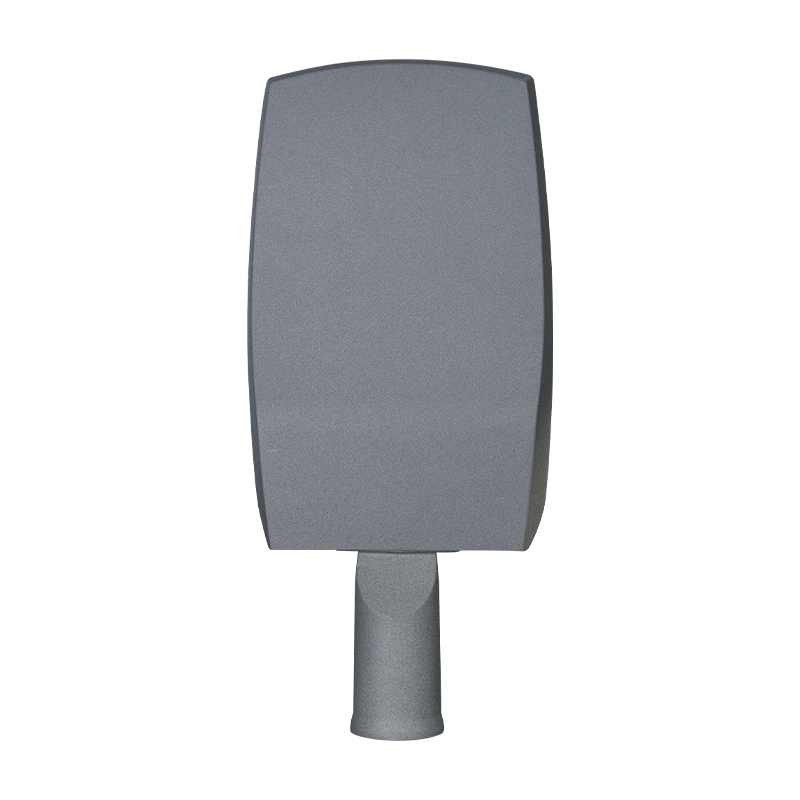 PY-LED612L-120W Stadium and Street LED LightA 120 W LED stadium/street light with die-cast aluminum housing and modular components; relevant for perimeter or cross-lighting when a full sports array is impractical.View Product →
Color Temperature, CRI, and Ball Visibility
Neutral and cool white light, often in the 4000 K to 5000 K range, gives good contrast for most outdoor pickleball courts. Very warm light can make the ball blend into the court, while excessively blue light can feel harsh at night. A color rendering index of 70 or higher is a reasonable baseline for sports play. For video, aim higher and keep color consistent across fixtures.
Also consider the court color. A blue or green playing area with a contrasting ball needs less visual effort than a low-contrast surface. Lighting cannot fix every surface problem, but it can make a good surface easier to read.
- Use the same color temperature across all fixtures on the court.
- Avoid mixing old and new LED types without checking color and output.
- Test with the actual ball and typical evening background.
Wattage, Energy, and Product Choice
Wattage is a result of the design, not a starting point. A 200 W fixture with the right optic can outperform a 400 W fixture aimed at the wrong place. Ask for a photometric file, a point by point layout, and a maintained output figure. Check the driver brand, surge protection, ingress rating, and warranty terms as well as the lumen number.
For larger multi-court facilities, high-output floodlights may be needed to reach tournament levels while keeping fixture count manageable. Those products should be specified with an engineered layout and a service plan, because maintenance access at height is part of the real cost.
 PY-SP08-1200W Low Energy Consumption Flood LightA 1200 W LED floodlight in the SP08 series, using high-efficiency chips, die-cast aluminum housing, and heat dissipation for demanding multi-court or industrial lighting layouts.View Product →
Controls, Commissioning, and Purchase Risks
Lighting controls are useful when they match how the court is booked. Separate switching for practice, league play, and cleaning can save energy without creating unsafe dark zones. Dimming should be tested at low levels, because some LED drivers flicker or shift color when dimmed far below their normal range.
Commissioning should include a night audit with a light meter and a visual check from both ends of the court. Look for glare at the baseline, shadowing near the net, and spill onto neighboring properties. A simple as built record with aiming angles, driver settings, and replacement part numbers will save time later.
Common purchase risks include buying by wattage alone, ignoring pole and foundation costs, and accepting a layout that only looks good on paper. For outdoor sports lighting, wind loading, corrosion protection, and access for maintenance matter as much as the initial light output. Review the sports lighting selection factors before finalizing a fixture schedule.
Solar or No Solar?
Solar pickleball court lighting can work for remote courts with good sun exposure and modest play hours, but it is not a direct swap for grid-powered sports lighting. Battery capacity, panel size, and winter performance must be sized for the actual use pattern. A court that runs three nights a week needs a very different system from one that runs six nights a week.
If the court already has reliable power, a grid-connected LED system is usually simpler to control and easier to maintain. If power is unavailable, treat solar as an energy system, not just a fixture. Check the battery chemistry, warranty, and replacement cost before committing.
A Practical Buyer Checklist
- Define the use level and target maintained footcandles before selecting fixtures.
- Require a photometric layout with uniformity and glare data for the actual pole positions.
- Choose asymmetric optics and shielding that keep the source out of player sight lines.
- Check color temperature, color consistency, and driver quality across the whole order.
- Plan service access, spare parts, and controls during the design stage, not after installation.
Get the Layout Right Before You Buy
Good pickleball court lighting is a balance of level, evenness, and visual comfort. Start with the player sight lines, set a realistic light level for the court use, and require a layout that shows how every fixture contributes. If you are planning a court or upgrading an existing one, talk through your court layout with a lighting supplier that can match optics, wattage, and mounting details to the site.
Previous Post
Pickleball Court Lighting Requirements: Lux Levels, Uniformity and Pole Height
Next Post
parts of a street lamp: Applications, Selection Criteria, and Practical Guidance
Related Products

Our Products
Keep In Touch
export@polaryang.cn
+86-574-65167530
Xue'ao Qiangjiao Town, Ninghai County, Ningbo, Zhejiang, China
Contact Us
Copyright © Ninghai Poda Electrical Appliance Co., Ltd. Rights Reserved.
Wholesale LED Lighting Manufacturer
OEM Solar Lighting Factory
