 English
 Español
+86-13777012108
(WhatsApp/WeChat)
Home / News / Industry News / Security Lighting Solutions: How to Specify Coverage, Controls, and Fixtures
Security Lighting Solutions: How to Specify Coverage, Controls, and Fixtures
A facility manager walks the rear of a distribution centre at night and finds the same problem many site owners describe: two high wattage floodlights make the loading dock bright enough to read a label, yet the fence line twenty metres away is completely black. The fixtures are not faulty. The layout is. Money was spent on output instead of coverage, and the dark gap is exactly where it matters most.
The conclusion first: reliable security lighting comes from matching fixture type, light distribution and enclosure protection to each zone, then buying hardware that survives the local weather and the local power supply. Wattage is the last variable to check, not the first. A well aimed 200 W unit regularly outperforms a 400 W unit that dumps light into one hot spot and leaves the perimeter unlit. What follows are the criteria that decide whether an installation still performs three winters after handover.
Content
- 1 What Security Lighting Has to Do Before Anything Else
- 2 Matching Fixture Types to Zones
- 3 The Numbers Behind a Layout That Works
- 4 Mains Power or Solar, Decided by Site Conditions
- 5 Controls That Keep the Scheme Useful After Year One
- 6 A Procurement Checklist for Buyers and Specifiers
- 7 Mistakes That Only Show Up After Handover
What Security Lighting Has to Do Before Anything Else
Exterior lighting for protection covers three jobs, and a scheme that only serves one of them will usually be judged a failure by the people who use the site.
- Deter. Continuous, even illumination of fences, gates, rear access routes and storage yards removes the shadows an intruder needs. Deterrence does not require blinding light levels, it requires the absence of concealment.
- Detect. Cameras and staff need enough light to recognise a face or a vehicle at a defined distance. Glare aimed into a lens cancels the benefit, so beam direction matters as much as lumen output.
- Move safely. Walkways, steps, staff car parks and fire exits need light levels that let people see the ground. Slips and falls are far more common on commercial sites than break ins.
Control strategy sits on top of these three jobs. Timed operation suits entries and facades, motion activation suits narrow access routes and storage yards, and continuous dimmed operation suits long perimeters where sensors create dark gaps between trigger points. Many mature sites now run a mix of all three on the same circuit rather than choosing one approach.
Matching Fixture Types to Zones
The practical unit of planning is the zone, not the building. Each zone has a mounting surface, an obstruction pattern and a viewing distance, and those three facts usually decide the fixture before price is discussed.
| Zone | Typical fixture | Working range | What decides success |
|---|---|---|---|
| Perimeter fence line | Asymmetric floodlight on pole or wall | 150 W to 300 W | Even distribution along the fence, no gap between adjacent heads |
| Loading dock, gate, alley | Wall pack or compact floodlight | 20 W to 60 W | Aim at face height, keep glare away from cameras |
| Yard, car park, service road | Street light or high output floodlight | 100 W to 240 W | Pole spacing in relation to mounting height |
| Entrance and facade | Wall pack, garden light | 8 W to 30 W | Coverage of door recesses and steps |
| Remote or unmetered site | Solar floodlight or solar street light | 40 W to 100 W | Battery autonomy through consecutive cloudy days |
For perimeter and yard work, a die cast aluminium floodlight body with a sealed driver compartment is the safer long term choice than thin folded steel, particularly on coastal sites where salt film accelerates corrosion around fasteners and cable entries. A 300 W wide beam unit with a corrosion resistant housing is a sensible reference point for a first layout study.
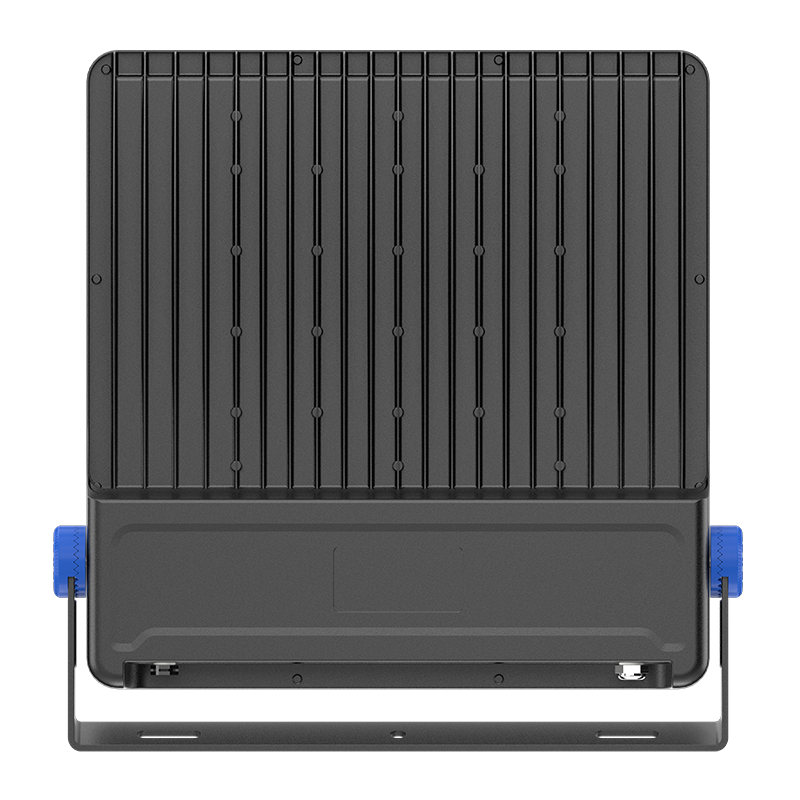 PY-FL05-300W Die-Cast Aluminum LED FloodlightA 300 W die-cast aluminium LED floodlight with IP67 sealing, suited to coastal perimeter layouts where corrosion-resistant housing and durable outdoor performance matter.View Product →
The Numbers Behind a Layout That Works
Once the zone and fixture family are settled, a short list of figures separates a specification that will hold up from one that will be re-lit in two years.
- Efficacy. Modern LED fixtures in the 120 to 150 lumen per watt band are normal. Anything far below that suggests older drivers and higher running costs across a long season of night operation.
- Uniformity. The ratio between the darkest and brightest points in a zone is what the eye and the camera actually register. Gaps between poles are usually a spacing problem, not a wattage problem.
- Colour temperature. 4000 K to 5000 K reads as neutral and supports recognition on camera. Very warm light looks welcoming but flattens detail at distance.
- Ingress and impact protection. IP65 is the working minimum for outdoor security fixtures, IP66 where driven rain or wash down occurs. IK08 covers most accidental contact in public areas.
- Surge protection. Pole mounted street and yard lights on exposed sites benefit from surge protection rated around 10 kV, which is cheaper than replacing drivers after every storm season.
- Beam angle. 60 degree beams throw further, 90 to 120 degree beams cover wider areas with less spill. Matching the optic to the pole height is the single most effective way to cut waste light.
Material choice belongs in the same conversation. Cast aluminium housings with a proper powder coat resist corrosion far better than painted sheet metal, and replaceable drivers or lens assemblies extend service life on sites where a lift or scaffold is needed for every repair.
Mains Power or Solar, Decided by Site Conditions
Solar is not a premium upgrade in every case, and it is not a shortcut in every case either. The decision rests on three local facts: how many hours of usable sun the site receives in the worst month, whether trenching to a grid connection is practical, and how much autonomy the operator needs during cloudy spells.
On a fenced yard or an access road with no existing supply, an integrated solar street light removes trenching, metering and cabling entirely, and installation usually takes a fraction of the time. Lithium iron phosphate batteries are the more durable option for hot climates because they tolerate cycling and elevated temperatures better than older chemistries. The trade off is that panel size and battery capacity must be sized for December, not for June. A unit that performs well in summer and dims by mid evening in winter has been specified against the wrong month.
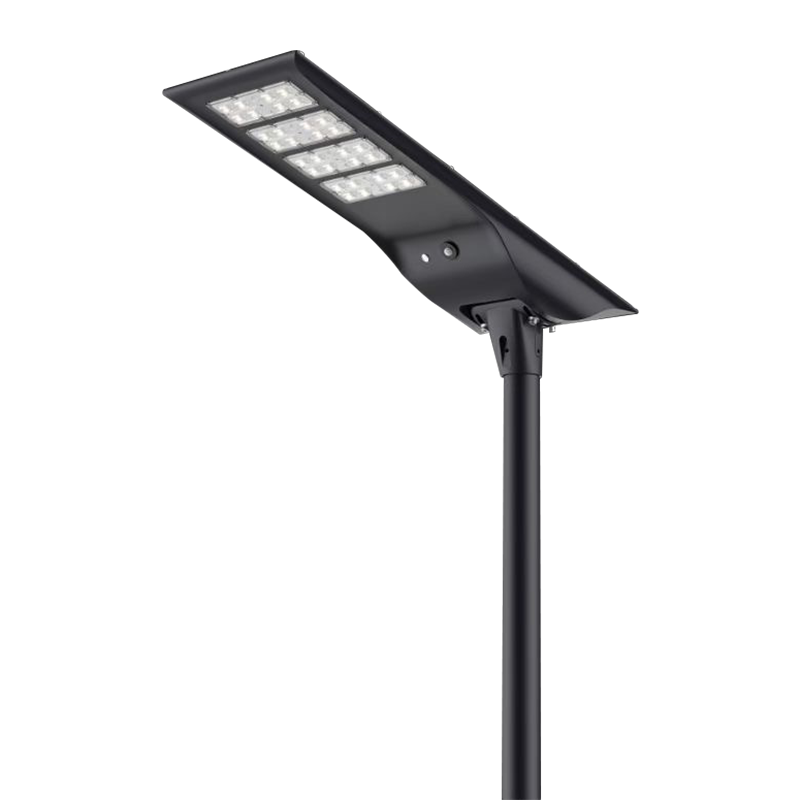 PY-SLST06-80W Solar Street Light with BatteryAn 80 W off-grid solar street light with integrated panel and battery, suited to fenced yards or access roads without an existing mains supply.View Product →
Where a supply already exists, mains powered LED remains the simpler route for high output zones such as yards lit for vehicle movement, because duty cycle and light level are not constrained by stored energy.
Controls That Keep the Scheme Useful After Year One
Controls decide whether the installation still suits the site once operating habits settle. Photocells and timers handle the basic schedule. Motion sensors add presence response on low traffic routes, though they need careful placement so that pedestrians are not left walking into a dark stretch after a light times out. Dimming profiles are often the better answer for perimeters, keeping a baseline of 30 to 50 percent output and lifting to full only when a trigger occurs.
Street and yard lighting has moved in the same direction. Smart street lights with programmable schedules and remote monitoring let an operator see which heads have failed before a complaint arrives, and let output follow actual traffic instead of running flat out from dusk to dawn. That combination typically cuts energy use without touching the deterrence value of the scheme.
 PY-LED666-240W Smart Street Light with Remote ControlA 240 W smart LED street light with programmable drivers and remote-management support, useful where scheduled dimming and failure visibility reduce operating costs.View Product →
The practical background on control architecture and its effect on operating cost is covered in this overview of smart street lighting applications, which is worth reading before committing to a control platform.
A Procurement Checklist for Buyers and Specifiers
Most complaints about security lighting trace back to information that was never requested at the quotation stage. A short checklist closes that gap.
- Ask for the actual light distribution file or a layout study, not just a wattage and a lumen figure. A photometric report shows where the light lands.
- Confirm certification for the destination market, typically CE, TUV and RoHS for European buyers, plus a documented quality management system behind the production line.
- Check housing material, coating thickness and fastener grade, especially for coastal or industrial atmospheres.
- Request driver brand, warranty terms and the price of a spare driver, since the driver is the part most likely to fail.
- Confirm lead time, packaging standard and whether customised housings, labels or colour temperatures are available for a project specific order.
- Order a sample and test it outdoors for a few nights before committing to a container volume.
Buyers working with an OEM manufacturer can usually resolve most of these points in one exchange if the enquiry includes the zone layout, the required light level and the destination market. Our team can support that review directly through the contact page, including sample requests and drawing level customisation.
Mistakes That Only Show Up After Handover
- Lighting the building and forgetting the approach. Intruders use the dark route to the door, not the door itself.
- Aiming floodlights horizontally. Tilting a head down to roughly 30 degrees reduces glare into cameras and neighbouring windows.
- Ignoring neighbour impact. Spill light onto adjacent property is the most common reason a scheme gets switched off, which defeats its purpose.
- Buying on wattage alone. Two 100 W fixtures from different suppliers can differ substantially in delivered lumens and beam shape.
- Skipping maintenance access. A fixture that needs a scaffold for every driver change will stay dark for months.
Security lighting rewards planning more than spending. Define what each zone must achieve, choose the fixture family that suits its mounting surface, verify the numbers that govern uniformity and durability, then select hardware that survives the weather and the power conditions on site. A layout built that way stays effective long after the novelty of a high wattage specification has worn off, and it is far easier to defend when someone asks why a particular light was chosen.
Previous Post
No previous article
Next Post
Softball Field Lighting Guide: Light Levels, Pole Layout, and LED Selection
Related Products

Our Products
Keep In Touch
export@polaryang.cn
+86-574-65167530
Xue'ao Qiangjiao Town, Ninghai County, Ningbo, Zhejiang, China
Contact Us
Copyright © Ninghai Poda Electrical Appliance Co., Ltd. Rights Reserved.
Wholesale LED Lighting Manufacturer
OEM Solar Lighting Factory
