 English
 Español


+86-13777012108
(WhatsApp/WeChat)
Home / News / Industry News / led parking lot lights retrofit: Applications, Selection Criteria, and Practical Guidance
led parking lot lights retrofit: Applications, Selection Criteria, and Practical Guidance
A 400 watt metal halide shoebox that has been running twelve hours a night for eight years still switches on at dusk. It also draws about 455 watts at the panel while producing roughly 60 percent of the light it delivered when new. That gap between still working and still performing is where parking lot lighting budgets quietly disappear.
The conclusion first: on a typical surface lot, replacing existing heads with LED luminaires cuts lighting energy by 50 to 70 percent and pays back in two to four years. What decides whether you reach that number is rarely the wattage printed on the spec sheet. It is whether the replacement matches the existing poles, the electrical supply, and the light levels the lot actually needs.
Content
- 1 What a Parking Lot Retrofit Actually Covers
- 2 Measure First: The Details That Decide Whether a Fixture Fits
- 3 Photometrics and Compliance: Compare Delivered Light, Not Watts
- 4 Controls That Shorten the Payback
- 5 Matching Fixture Types to Zones in the Lot
- 6 The Payback Math and the Risks That Break It
- 7 Sourcing, Customization and Certification Checks
What a Parking Lot Retrofit Actually Covers
Retrofit is used loosely in this market. On site it means one of three things, and they produce very different results.
- Lamp level retrofit. Keep the housing, swap the lamp and bypass or replace the ballast. Lowest cost per fixture, but the old optics, lens and gaskets stay in service, so glare and uniformity usually do not improve.
- Luminaire level retrofit. Remove the old head and mount a new LED fixture on the existing tenon or arm. This is what most projects actually do.
- Full assembly replacement. New pole, new arm, new fixture. Justified when poles are corroded, when base bolts are failing, or when the layout itself is wrong.
The middle route captures nearly all of the energy savings while reusing the pole, base and underground conduit. It also lets you correct photometric problems, because you are selecting a new distribution pattern instead of inheriting the old one.
Measure First: The Details That Decide Whether a Fixture Fits
Six items from a site walk and a look at the panel schedule prevent almost every ordering mistake.
- Supply voltage and phase. Parking lots commonly run 120, 208, 240, 277 or 480 volts. Confirm single or three phase and whether the existing fixtures use a multi tap ballast.
- Existing input wattage, not lamp wattage. A 400 watt metal halide lamp with a magnetic ballast draws about 455 watts at the panel, and that number sets your savings baseline.
- Tenon and arm geometry. Slip fitter diameter of 2 3/8 in or 3 in, tenon length, arm reach, and round versus square pole. Adapter brackets exist, but each one adds a joint that has to survive wind.
- Mounting height and spacing. Twenty to thirty feet is typical. Uniformity depends on the spacing to height ratio far more than on total fixture count.
- Existing controls. A photocell, contactor or time clock may be wired ahead of the fixtures. Decide whether new drivers are controlled individually or by the same circuit.
- Fixture weight and effective projected area. A heavier head on a tall pole changes the wind load the pole was designed for.
Skipping this step is the most common reason a retrofit order arrives, gets installed, and then has to be corrected with adapters, re-drilled tenons or replacement drivers.
Photometrics and Compliance: Compare Delivered Light, Not Watts
Parking lot lighting is normally designed to recommended practice targets of about 0.5 to 1.0 average footcandles across the parking surface, with higher levels of roughly 2 footcandles at pedestrian routes and entries. Uniformity matters as much as average level: a maximum to minimum ratio of 10 to 1 or tighter keeps a lot from looking like a checkerboard of bright pools and dark gaps.
This is why lumen output alone is a poor comparison. A 400 watt metal halide lamp starts near 36,000 lumens but its mean output over life is closer to 24,000, while a 150 watt LED street light at about 150 lumens per watt holds roughly 22,500 lumens with far less depreciation. On paper the figures look similar; on the ground, the LED version usually looks brighter and more even.
Check the items that affect approval and rebate eligibility: a full cutoff or controlled BUG rating if the site sits under a dark sky ordinance, listing for wet locations, an IP65 or IP66 rating on the optical chamber, surge protection rated at 10 kV, and a warranty of at least five years on both driver and LED module. Products on the DesignLights Consortium qualified products list are usually required before a utility releases an incentive.
Controls That Shorten the Payback
Controls are where a retrofit can outperform its own energy calculation. A photocell plus a time clock trims the hours the lot is lit. Occupancy sensors that drop output to 30 percent when an area is empty commonly add 20 to 40 percent savings in low traffic lots, and networked control systems often unlock a larger utility rebate than the fixtures alone.
Specify fixtures that accept 0 to 10 volt dimming or integrated sensor modules so that controls can be added later without replacing the luminaire. Control ready heads such as the 240 W smart street light in our street light range are built for exactly that upgrade path.
 PY-LED666-240W Smart Street Light with 0-10V DimmingControl-ready 240 W street light with 0-10V/DALI driver options, IP66 protection and multiple optics, suited to later control upgrades in outdoor lighting.View Product →
Matching Fixture Types to Zones in the Lot
Parking lots are not one lighting problem; they are three or four.
Drive aisles and perimeter rows
Shoebox style street lights in the 100 to 240 watt range on 20 to 30 foot poles handle most aisle lighting. They give a controlled, forward throwing distribution that keeps light on the pavement rather than in the windows of neighboring buildings.
Open areas and irregular layouts
Where spacing is uneven, or where one large area needs coverage from a single position, an area flood fixture with a wider beam is more efficient than forcing a street light pattern to do the job. A 300 W flood light is a common choice for large lots, equipment yards and storage areas.
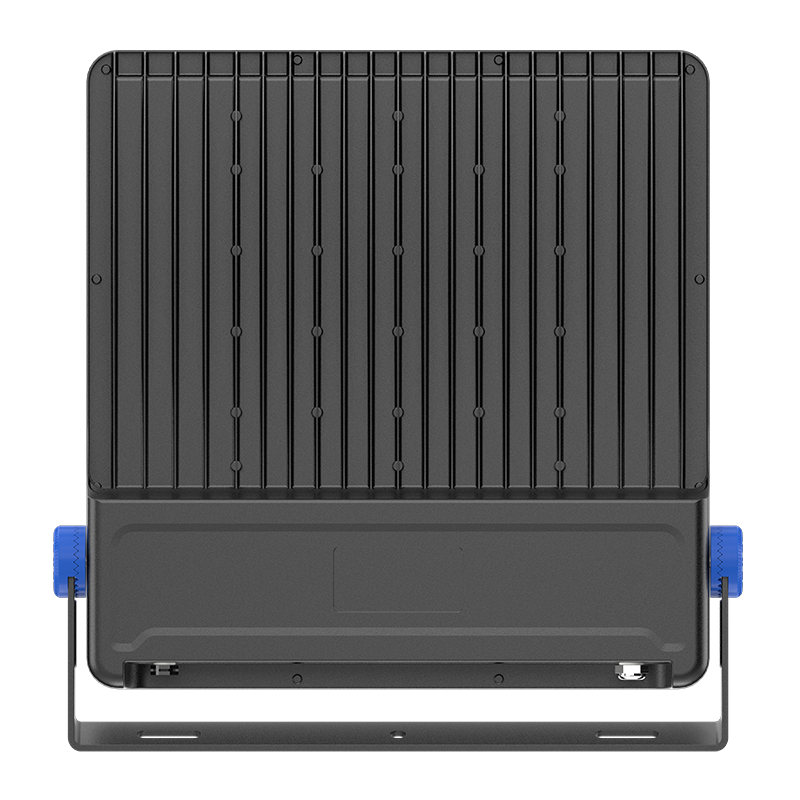 PY-FL05-300W Outdoor LED Flood Light for Large Areas300 W die-cast aluminum floodlight with IP67 housing and CRI 80+, suited to large lots, equipment yards and storage areas.View Product →
Building mounted and service areas
Entry doors, stairwells, dumpster enclosures and loading bays are better served by wall mounted units than by pole lights. Cast aluminum wall packs rated for outdoor use take the abuse of a service area and keep light where people walk.
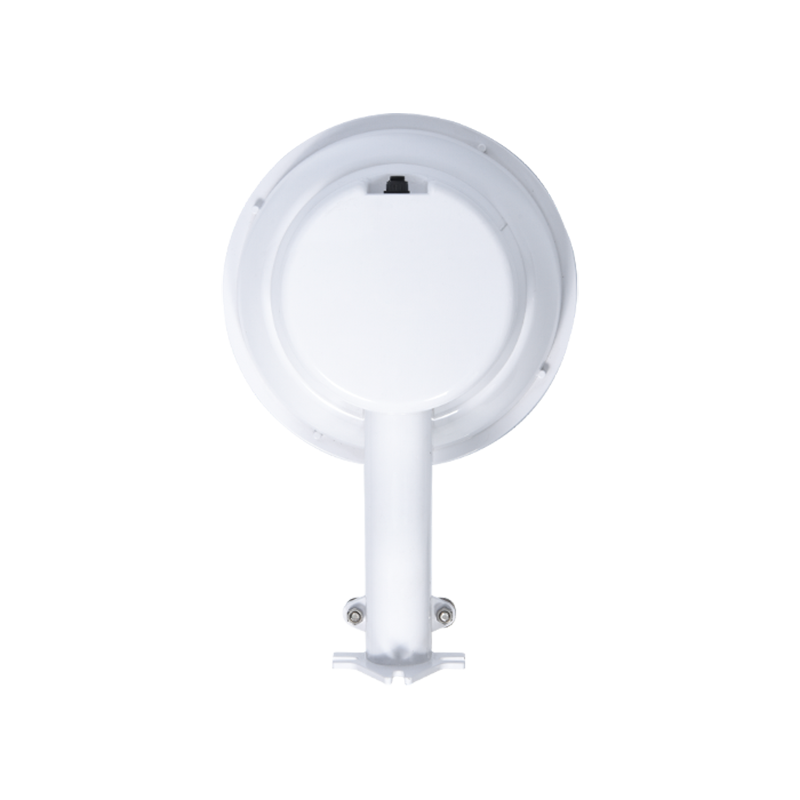 PY-WP9004 Outdoor Waterproof Wall Pack LightIP65 aluminum wall pack for courtyards, balconies, hallways and garages, suited to entry, stairwell and service-area lighting.View Product →
The Payback Math and the Risks That Break It
The table below shows what a single fixture swap is usually worth. Multiply by the number of poles to size the project.
| Existing system | Input watts | LED replacement | LED input watts | Annual kWh saved | Annual cost saved |
|---|---|---|---|---|---|
| 250 W high pressure sodium | 295 | 100 W LED street light | 100 | 780 | 94 USD |
| 400 W metal halide | 455 | 150 W LED street light | 150 | 1,220 | 146 USD |
| 1,000 W metal halide, high mast | 1,080 | 300 W LED flood light | 300 | 3,120 | 374 USD |
The arithmetic is simple; the execution risk is not. Three things routinely eat into payback. First, lead time, because a partially retrofitted lot looks worse than either the old or the new version. Second, warranty terms, so confirm who pays return freight and how a spare driver is supplied years later instead of assuming the lowest price carries the same support. Third, verification, which means buying two or three sample units, installing them on the worst lit poles, and measuring with a light meter at night before releasing the full order.
Sourcing, Customization and Certification Checks
Parking lot retrofits often need small deviations from a catalog part: a specific color temperature, a different wattage step, a longer mounting arm, or a housing finish that matches an existing installation. A supplier that develops its own molds and tooling in house can accommodate that without a long changeover, and one that already holds CE, TUV and ROHS documentation avoids a compliance scramble at the port.
It also helps to see where the wider market is heading. The move toward LED street lighting in urban environments shows the same pattern at city scale, where replacement programs became standard practice once the operating cost case was proven.
If you are planning a project, send the pole and site details to our team along with the existing wattage and the light levels you need. Fixture selection follows from those numbers rather than from a guess.
An LED parking lot lights retrofit is less about buying LED fixtures than about matching them to what is already on site. Measure the existing system, compare delivered footcandles rather than watts, keep controls in the plan, and verify with a sample install. Do those four things and the two to four year payback stops being a promise and becomes a number you can defend in a budget meeting.
Previous Post
LED Soccer Field Lighting: Lux Levels, Pole Layout, and Luminaire Choice
Next Post
LED Parking Lot Lighting: How to Choose Wattage, Optics, and Pole Layout
Related Products

Our Products
Keep In Touch
export@polaryang.cn
+86-574-65167530
Xue'ao Qiangjiao Town, Ninghai County, Ningbo, Zhejiang, China
Contact Us
Copyright © Ninghai Poda Electrical Appliance Co., Ltd. Rights Reserved.
Wholesale LED Lighting Manufacturer
OEM Solar Lighting Factory
