 English
 Español
+86-13777012108
(WhatsApp/WeChat)
Home / News / Industry News / Basketball Court Lighting Design Guide: Lux Levels, Layout and LED Solutions
Basketball Court Lighting Design Guide: Lux Levels, Layout and LED Solutions
Friday evening at the neighborhood court, half of the players stop coming. The far basket sits in shadow, the light pole near the fence throws long dark streaks across the free throw line, and every rebound under the rim happens out of sight. The usual response is to add a bigger lamp or another fixture, but basketball court lighting design is a system problem. This guide explains each parameter in order of impact so you can write a clear specification and compare supplier offers with confidence.
Content
Set the Lux Target First
Every design decision follows from one number: the average horizontal lux level required for the level of play. Lux measures the luminous flux that lands on each square meter of the playing surface. A casual driveway game can work at 150 to 200 lux, while a school league match usually needs 300 lux, a regional club competition around 500 lux, and a venue with television coverage at least 750 lux.
| Court level | Average horizontal lux | Uniformity (min/avg) | Typical pole height |
|---|---|---|---|
| Backyard or driveway | 150-200 | 0.4 | 6-8 m |
| School or community | 300 | 0.5 | 8-10 m |
| Club league or regional | 500 | 0.6 | 10-12 m |
| Professional or TV broadcast | 750-1000 | 0.7 | 12-15 m |
Horizontal lux targets by court level
This chart compares the horizontal lux targets from the table on a single scale. A TV broadcast installation requires roughly four times the illuminance of a backyard court, which means more poles, taller mounting heights, or higher output luminaires. The numbers also reveal why a casual court should not copy a stadium design: over-lighting produces glare and operating waste. Uniformity matters as much as the average figure; if the corners receive only 30 percent of the center illuminance, players lose depth perception under the basket. Ask any lighting supplier for a photometric report that shows the average lux and the min-to-average ratio for the proposed pole layout.
LED Versus Metal Halide: Wattage for Wattage
Older courts still run on metal halide, but the math does not support that choice for a new installation. A typical 1000W metal halide lamp produces 60,000 to 80,000 lumens and draws about 1100W with ballast loss. A 400W LED flood light delivers a similar output at roughly one third of the input power, with better color rendering and instant start.
Equivalent wattage pairs for court retrofits
The horizontal bars compare the common wattage pairs used in court retrofits. In every pair, the LED fixture uses one third to one quarter of the metal halide power while producing equivalent lumen output along the court. A four-fixture competition court that previously drew 4000W from four 1000W metal halide lamps can run on four 400W LED units at 1600W total. This difference changes the supply cable size, the circuit breaker rating, and the thermal load on the pole top. Lower current also simplifies generator backup for events and reduces the risk of nuisance tripping on older electrical panels.
When replacing lamp by lamp, a standard two-pole or four-pole court uses a 400W LED flood light in place of a 1000W metal halide fixture. A small half-court can run on a 150W LED unit where a 400W metal halide once stood. The category of fixture matters too: wide-beam LED flood lights work best for backyard setups, while competition courts usually need medium beam optics that focus the light on the court surface and keep it off the run-off area. Read the detailed considerations for choosing LED stadium lights before you finalize the pole structure and cabling. The electrical savings alone, roughly 60 percent of the lighting load, usually covers the fixture cost within two to three seasons of regular evening play.
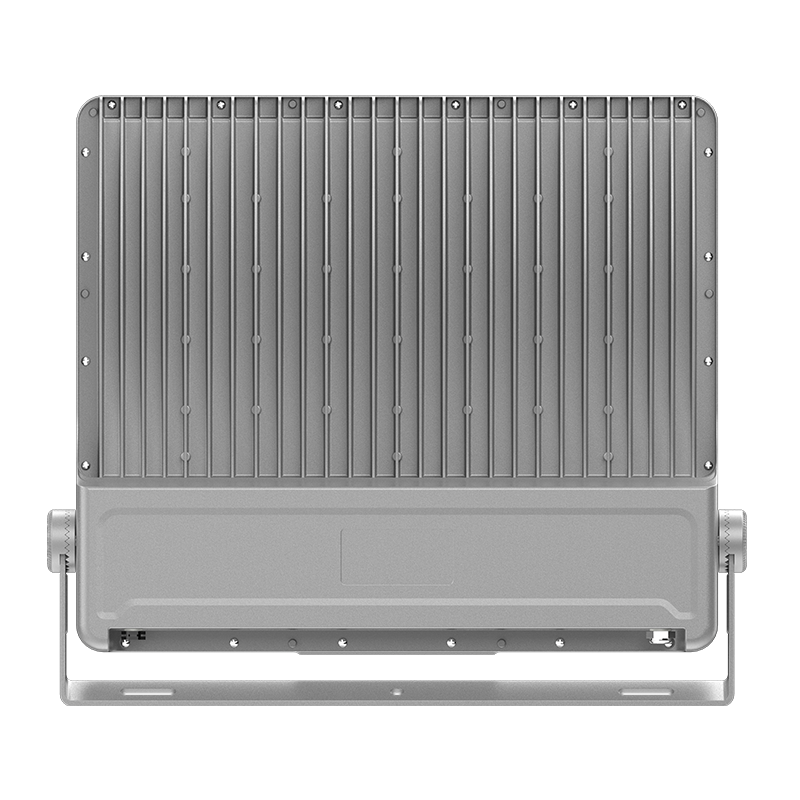 PY-FL02-400W LED Flood Light for Courts and Large AreasThis 400W LED flood light is presented as an energy-saving replacement for 1000W metal halide fixtures, with IP65 protection and wide temperature operation, suitable for raising on 6m to 10m poles for court lighting.View Product →
Pole Height and Fixture Layout
Mounting height decides both the shape of the light pool and the number of poles. A 6m pole produces a bright spot directly underneath and a fast falloff toward mid-court, so a full-size court needs four to six of them. Raising the same fixture to 10m spreads the beam over a larger area, improves uniformity, and reduces the visible contrast between bright and dark zones.
Relative illuminance decay with distance from the pole
The line chart shows how relative illuminance decays as the distance from the pole increases, for three mounting heights. A 6m installation loses more than half of its illuminance by the center of a typical court, which forces the eye to adapt constantly. An 8m pole keeps more of the light inside the playing area, but the gradient is still visible near the sideline. A 10m mounting height produces a much flatter curve, meaning the difference between the brightest and darkest zones stays within a comfortable range. This confirms the practical rule that competitive play requires the highest practical pole height.
The flatter curve at 10m is exactly what players describe as even lighting. For recreational play, 8m poles with four corners positioned 3 to 4m outside the court boundary are the most common layout because they keep the light at a safer angle. For competition courts, 10 to 12m poles with elevated crossarms keep the glare above the player sightline, which is a requirement in most club standards. Many facility managers also ask for a second row of poles along the sideline; that layout pushes the vertical illuminance up without creating hot spots under the baskets. If you are lighting a smaller practice court or a driveway half-court, a compact pole-mounted luminaire with a 120 degree beam delivers enough coverage from a single point.
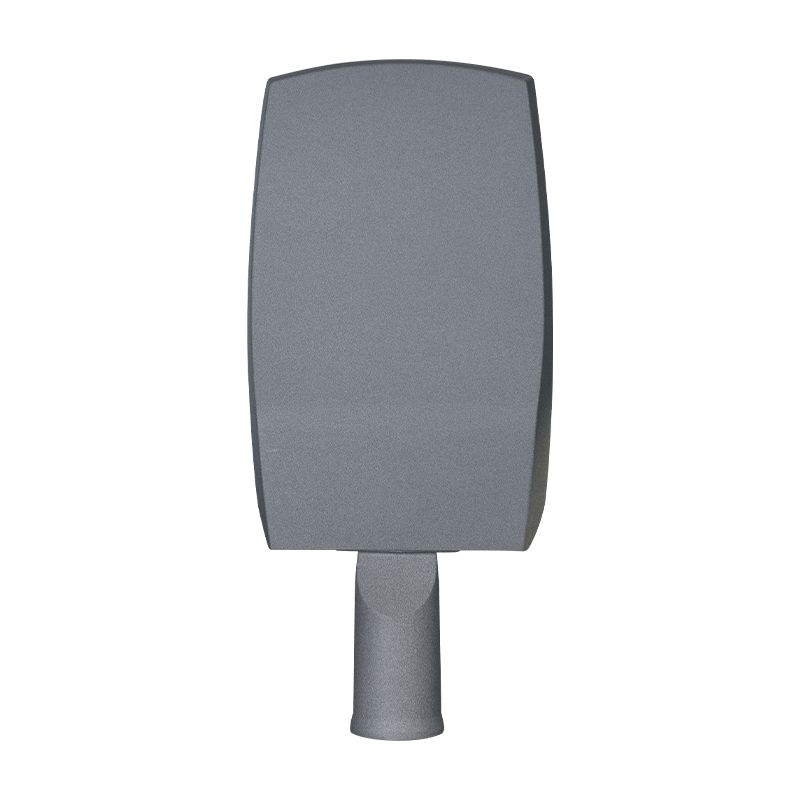 PY-LED612L-120W Outdoor Stadium and Court Pole LightA compact 120W pole-mounted LED luminaire with a 120-degree beam and IP67 rating, aligned with the article's guidance for small courts or driveway half-courts needing even coverage from a single point.View Product →
Beam Angle, Glare, and Color Quality
Beam angle defines how the luminaire spreads its light. Flood lights for basketball courts come in narrow (30 to 60 degrees), medium (60 to 90 degrees), and wide (90 to 120 degrees) types. Short poles and small courts want wide beams; tall poles and large courts combine medium and narrow beams aimed from fixed positions to cover the court in overlapping ellipses.
Glare is the second constraint that most first-time buyers forget. A bare bright source in the player sightline reduces contrast and causes complaints from neighboring properties. Fixtures should include visors, shields, or an optical design that caps the light at 65 to 75 degrees above horizontal for outdoor installations. Color rendering also deserves attention: a CRI of at least 70 is acceptable for practice, but 80 or higher makes the ball and the line markings much easier to track under fast movement.
LED versus metal halide: attribute comparison
The radar chart compares LED and metal halide across six attributes that matter to a court owner. LED leads on energy efficiency by a wide margin because it converts a larger share of input power into visible light. Color rendering, marked as CRI, is better with LED, which helps players read the court and the ball accurately. Lifetime reflects the 50,000 hour rating of a quality LED module against the 10,000 hour life of a metal halide lamp. Dimming and instant start are the two operational advantages that change daily use; an LED system can switch on and off freely without the long warm-up and restrike delay of discharge lamps. Heat control is shown from the safety and efficiency side, since LED keeps most of its energy inside the optical chamber rather than radiating it toward the playing surface.
Outdoor Durability and Electrical Protection
An outdoor basketball court is a harsh environment for electrical equipment. Rain, UV, dust, wind, and occasional ball impacts all attack the fixture. For outdoor installations, an IP65 rating is the practical minimum, and IP66 is strongly preferred for luminaires mounted below 8m where irrigation and splash are more likely. Surge protection of at least 10kV is recommended for long cable runs and areas with frequent thunderstorms.
The housing deserves as much attention as the LED module. Die-cast aluminum with a corrosion-resistant finish has proven to be the most reliable structure for court lighting, because it conducts heat away from the LED junction and survives years of outdoor exposure. Polycarbonate lenses resist impact better than glass in public courts, and gasketed covers prevent moisture from reaching the driver. If the site is close to the coast, salt spray resistance should be written into the specification. Compare these mechanical details when you receive quotes, because two fixtures with the same lumen output can differ by five or more years in service life. For a full-size outdoor court, a 960W LED flood light with die-cast housing and IP66 protection is a practical choice in the 800 to 1200W class. Browse the LED flood light range to see housings and power levels from 50W to 1200W before setting the final budget.
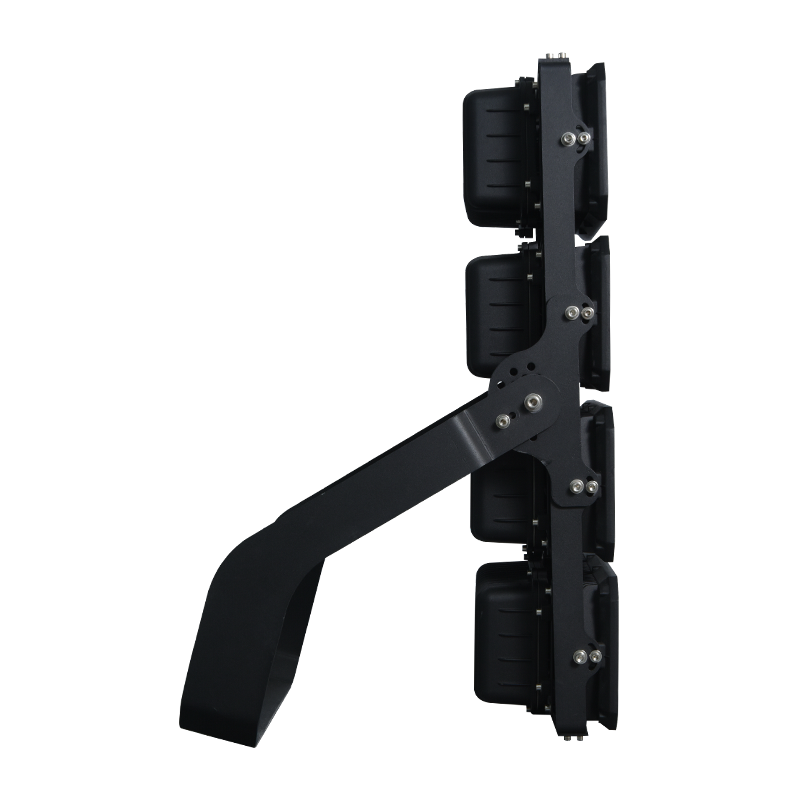 PY-LED553-960W Outdoor Flood Light with Durable HousingA heavy-duty 960W flood light with die-cast aluminum housing and IP66 protection, cited earlier as a practical full-size court option; its robust build and high lumen output suit venues requiring long service life and smart controls.View Product →
Smart Controls and Running Costs
Smart controls convert a good lighting system into an efficient one. A dimmable driver lets the court run at 100 percent for league nights and 50 to 70 percent for casual play, which also extends the service life of the LED modules. Motion sensors switch the system off when the court is empty, a major saving for school and community venues that stay open until late. Common control features include:
- Dimmable drivers: lower output to 50-70 percent on practice nights.
- Motion sensors: switch off automatically after ten minutes without movement.
- Astronomical timer: adapts start and stop times to local sunset.
- 0-10V control loop: works with standard building automation panels.
On a typical four-fixture court, the numbers tell a clear story. A metal halide system with four 1000W lamps draws about 4000W and costs around 1750 dollars per year to run for eight hours every day at an electricity price of 0.15 dollar per kWh. The LED replacement with four 400W fixtures uses about 1600W and costs roughly 700 dollars per year with identical operating hours. Adding occupancy control cuts that figure by another 20 to 40 percent depending on usage patterns. Most modern LED drivers accept 0-10V dimming, which requires only a two-wire control loop and works with standard astronomical timers. With this combination, the payback period for most court retrofits lands between two and three years.
Put the Design Together
A basketball court lighting design succeeds when it balances four things: a measured lux target, a uniform beam layout, a mounting height that controls glare, and fixtures built to survive the site conditions. Start with the highest level of play the court will host, set the lux level honestly, then ask suppliers for a photometric simulation of the exact pole layout. If the supplier cannot provide the average lux and uniformity values in writing, treat the offer as incomplete no matter how attractive the fixture price. LED equipment now removes the classic trade-offs of heat, warm-up time, and lamp replacement, so the only difficult part is the geometry of the layout. A clear specification and a durable IP66 luminaire will give a court dependable night play for decades with minimal maintenance.
Previous Post
Car Dealership Building Lighting: Specs, Levels, and LED Retrofit Guide
Next Post
450 Lumens Explained: Brightness, Beam Angle, and Real-World Applications
Related Products

Our Products
Keep In Touch
export@polaryang.cn
+86-574-65167530
Xue'ao Qiangjiao Town, Ninghai County, Ningbo, Zhejiang, China
Contact Us
Copyright © Ninghai Poda Electrical Appliance Co., Ltd. Rights Reserved.
Wholesale LED Lighting Manufacturer
OEM Solar Lighting Factory
