 English
 Español
+86-13777012108
(WhatsApp/WeChat)
What's the difference between LED High Bay Lights and low bay lights?
LED high bay lights are designed for ceilings above 6 metres (20 feet), while low bay lights are intended for ceilings between 3 and 6 metres (10–20 feet). The mounting height dictates everything else — wattage, beam angle, lumen output, housing design, and optics all differ significantly between the two types. Choosing the wrong one results in either under-lit work areas or wasted energy and uncomfortable glare.
Content
- 1 Mounting Height: The Defining Factor
- 2 Wattage and Lumen Output: Power Matched to Distance
- 3 Beam Angle and Optical Design
- 4 Physical Design and Housing
- 5 Heat Management and Thermal Performance
- 6 IP Rating and Environmental Suitability
- 7 Light Quality: Uniformity, Glare Control, and Colour Rendering
- 8 Energy Efficiency and Running Costs
- 9 Full Side-by-Side Comparison
- 10 How to Choose the Right Type for Your Space
Mounting Height: The Defining Factor
The primary classification of any bay light is determined by the height at which it will be installed:
| Light Type | Typical Mounting Height | Typical Applications |
|---|---|---|
| Low Bay | 3 m – 6 m (10–20 ft) | Retail stores, small workshops, garages, supermarkets |
| High Bay | 6 m – 20 m (20–65 ft) | Warehouses, factories, sports halls, aircraft hangars |
Installing a low bay light at high bay heights produces insufficient illuminance at floor level because the light cannot travel the additional distance without significant intensity loss. Conversely, using a high bay light at low ceiling heights creates harsh glare and excessive brightness that is uncomfortable for occupants.
Wattage and Lumen Output: Power Matched to Distance
Light intensity diminishes with distance according to the inverse square law — doubling the distance reduces illuminance to one quarter. High bay lights must therefore produce significantly more lumens to deliver adequate foot-candle levels at floor level:
| Light Type | Typical Wattage Range | Typical Lumen Output | Target Floor Illuminance |
|---|---|---|---|
| Low Bay | 40 W – 150 W | 4,000 – 18,000 lm | 200 – 500 lux |
| High Bay | 100 W – 500 W+ | 12,000 – 65,000 lm | 200 – 500 lux (at greater distance) |
For a practical example: a 150 W LED high bay in a warehouse with a 10-metre ceiling can deliver approximately 300 lux at floor level — a suitable level for general warehouse picking operations. A 150 W low bay light in the same space would produce less than 100 lux at floor level, far below the recommended minimum.
Beam Angle and Optical Design
Beam angle is directly tied to mounting height and coverage area requirements. This is one of the clearest technical distinctions between the two types.
High Bay Light Optics
High bay lights typically use narrow beam angles between 60° and 90°. A tighter beam concentrates the high lumen output into a focused cone, ensuring sufficient intensity reaches the floor from a greater height. Some high bay models offer interchangeable optical lenses — allowing beam angles of 60°, 90°, or 120° — to suit different aisle widths and racking configurations.
Low Bay Light Optics
Low bay lights use wider beam angles, typically 90° to 120°, sometimes with diffused or prismatic covers. Because the mounting distance to the work surface is shorter, a wider spread distributes light more evenly across a larger area per fixture, reducing the number of units required and minimizing dark spots between fittings. Special optical lenses or reflective cups help control glare and deliver uniform illumination that reduces visual fatigue for workers and improves visibility of fine details at close range.
Physical Design and Housing
The physical form of high bay and low bay lights differs noticeably, reflecting their different functional demands.
High Bay Light Housing
High bay lights come in two dominant form factors:
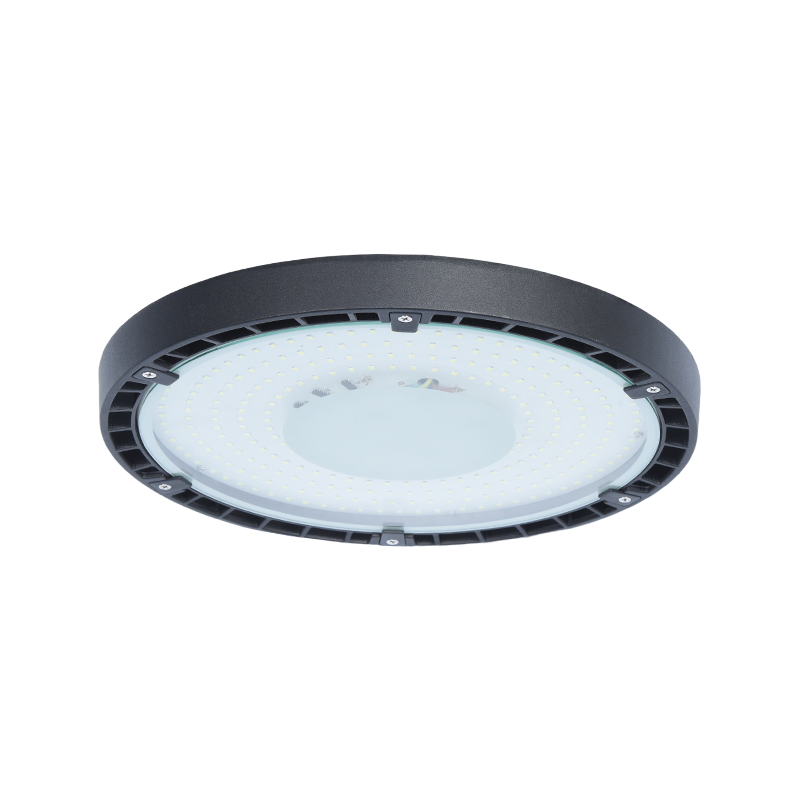
- UFO (round) high bay: A compact disc-shaped design with integrated heat sink fins around the perimeter. Typically available from 100 W to 300 W+. Efficient to install, easy to aim, and suitable for most warehouse and industrial environments.
- Linear high bay: A rectangular strip design that provides elongated coverage along aisles and conveyor lines. Better suited to narrow, long spaces such as storage aisles or production lines.
Both types are constructed from high-strength die-cast aluminium, which provides excellent mechanical strength and corrosion resistance. Surfaces are typically treated with anti-aging electrostatic powder coating to resist chemical exposure and high-humidity environments — essential for industrial and food production facilities.
Low Bay Light Housing
Low bay lights tend to use wider, flatter designs — either a shallow round or square profile — with diffused covers or open reflectors. The lower heat generation at lower wattages allows for lighter housing materials in some applications, though commercial-grade models still use aluminium construction for longevity. Many low bay fixtures include a prismatic or opal diffuser to further soften the light output and minimize direct glare at close range.
Heat Management and Thermal Performance
High bay lights generate more heat due to their higher wattage, making thermal management more critical:
- High bay lights feature deep, densely-finned aluminium heat sinks that dissipate heat efficiently. Maintaining LED junction temperature below 85°C is essential to achieving the rated 50,000+ hour lifespan. Some high-power models (300 W+) incorporate active cooling fans for additional thermal management.
- Low bay lights operate at lower wattages and generate proportionally less heat, allowing passive cooling through a simpler heat sink profile. This contributes to a lighter, more compact fixture suitable for lower-headroom environments.
In both types, the die-cast aluminium body serves a dual purpose: structural protection and heat conduction away from the LED chips to the outer surface, where ambient air dissipates it passively.
IP Rating and Environmental Suitability
Both high bay and low bay lights are available with IP (Ingress Protection) ratings suited to industrial environments, but the specific requirements often differ by application:
| IP Rating | Protection Level | Typical Environment |
|---|---|---|
| IP44 | Splash-proof | General retail, dry warehouses |
| IP65 | Dust-tight, water jet resistant | Factories, food processing, car parks |
| IP66 | Dust-tight, powerful water jet resistant | Wash-down environments, cold stores |
| IP67 | Dust-tight, temporary immersion | Outdoor covered areas, chemical plants |
For most warehouses and factories, IP65 is the recommended minimum. Environments with regular wash-downs or chemical spray should specify IP66 or higher. The anti-aging electrostatic surface treatment on quality die-cast aluminium housings adds a further layer of protection against corrosion from chemical vapour and humidity.
Light Quality: Uniformity, Glare Control, and Colour Rendering
Both light types use precision optical systems — lenses and reflective cups — to manage light distribution, but the engineering priorities differ:
Uniformity
Good bay lighting achieves a uniformity ratio (minimum to average illuminance) of 0.7 or higher. Low bay lights, being closer to the work surface, can achieve high uniformity with wider beam angles and moderate fixture spacing. High bay lights require careful photometric planning to achieve the same uniformity ratio at greater heights, typically requiring closer fixture spacing or asymmetric optics in aisle configurations.
Glare Control
Glare is a more acute issue with low bay lighting because fixtures are closer to eye level. Quality low bay lights use diffusers, prismatic covers, or deep-set optics to control the Unified Glare Rating (UGR). A UGR below 22 is recommended for industrial workplaces; UGR below 19 is required for tasks requiring fine visual detail. Excessive glare increases visual fatigue and reduces worker productivity over extended shifts.
Colour Rendering Index (CRI)
Both light types should have a CRI of 80 or above for general industrial use, and CRI 90+ for environments where accurate colour assessment is required (quality inspection, paint matching, food processing). Higher CRI values make fine details clearer and operations safer, particularly when identifying material types, reading labels, or checking product quality on a production line.
Energy Efficiency and Running Costs
LED technology delivers substantial energy savings over traditional metal halide or fluorescent bay lighting in both categories. A direct comparison against legacy systems shows the scale of the benefit:
| Technology | Typical Efficacy (lm/W) | Rated Lifespan | Energy vs Metal Halide |
|---|---|---|---|
| Metal Halide (HID) | 75 – 100 lm/W | 6,000 – 15,000 hrs | Baseline |
| Fluorescent (T5/T8) | 80 – 100 lm/W | 10,000 – 20,000 hrs | –10 to –20% |
| LED High/Low Bay | 130 – 180 lm/W | 50,000 – 100,000 hrs | –40% to –60% |
In a facility running lights for 16 hours per day, 365 days per year, replacing 400 W metal halide high bay fixtures with 150 W LED equivalents saves approximately 250 W per fixture — a reduction of 62.5%. Across 50 fixtures in a medium warehouse, this equates to annual energy savings of over 73,000 kWh, delivering a typical payback period of 2–4 years.
Full Side-by-Side Comparison
| Specification | LED High Bay | LED Low Bay |
|---|---|---|
| Mounting height | 6 m – 20 m | 3 m – 6 m |
| Wattage range | 100 W – 500 W+ | 40 W – 150 W |
| Lumen output | 12,000 – 65,000 lm | 4,000 – 18,000 lm |
| Beam angle | 60° – 90° | 90° – 120° |
| Housing material | Die-cast aluminium | Die-cast aluminium |
| Common form factor | UFO round / Linear strip | Shallow round / Square panel |
| Heat sink depth | Deep, densely finned | Shallower profile |
| Glare management | Optical lens / reflector | Diffuser / prismatic cover |
| Typical applications | Warehouses, factories, sports halls | Retail, small workshops, car parks |
How to Choose the Right Type for Your Space
Use these practical decision criteria when specifying bay lighting for a new installation or retrofit:
- Measure your clear ceiling height first. If your ceiling is below 6 metres, specify low bay. At 6 metres and above, specify high bay. Do not rely on estimates — incorrect height classification is the leading cause of lighting underperformance.
- Define your target illuminance. General warehousing requires 200 lux; assembly work or retail typically requires 300–500 lux. Use a photometric simulation (IES file calculations) to confirm fixture spacing achieves your target uniformly.
- Check the environment's IP requirements. Dusty or wet environments need IP65 as a minimum. Wash-down areas need IP66 or IP67.
- Consider controls compatibility. Both high bay and low bay LED fixtures are available with 0–10 V dimming, DALI, or built-in motion sensors. Adding occupancy sensing to warehouse bay lighting typically reduces energy consumption by a further 20–40%.
- Evaluate colour rendering requirements. General storage needs CRI 80+. Quality inspection, food handling, or retail display areas benefit from CRI 90+ for accurate colour perception and operational safety.
Previous Post
What are the advantages of LED Street Light?
Next Post
What is the Working Principle of an LED Street Light?
Related Products

Our Products
Keep In Touch
export@polaryang.cn
+86-574-65167530
Xue'ao Qiangjiao Town, Ninghai County, Ningbo, Zhejiang, China
Contact Us
Copyright © Ninghai Poda Electrical Appliance Co., Ltd. Rights Reserved.
Wholesale LED Lighting Manufacturer
OEM Solar Lighting Factory
