 English
 Español
+86-13777012108
(WhatsApp/WeChat)
Which is better, solar-powered outdoor lights or LED garden lights?
For most permanent garden installations, wired LED garden lights outperform solar-powered outdoor lights on every measurable metric that matters most: brightness, consistency, reliability, and long-term value. Solar lights win on installation simplicity and off-grid convenience, making them the better choice in specific situations — remote locations without mains access, temporary lighting, or supplemental accent lighting where moderate output is sufficient. But for a permanent, high-performance garden lighting solution that delivers consistent illumination night after night regardless of season or weather, a quality LED Garden Light connected to the mains supply is the more dependable investment. The sections below break down this comparison across every dimension that matters to a real-world buying decision.
Content
- 1 Understanding the Core Technology Difference
- 2 Brightness and Light Output: A Decisive Advantage for Wired LED
- 3 Reliability and Consistency: The Solar Light's Fundamental Weakness
- 4 Installation: Solar Wins on Simplicity, LED Wins on Permanence
- 5 Lifespan and Total Cost of Ownership
- 6 Light Quality: Color Rendering, Color Temperature, and Control
- 7 Environmental Impact: A More Nuanced Comparison Than It Appears
- 8 When Solar-Powered Outdoor Lights Are the Right Choice
- 9 When Wired LED Garden Lights Are the Right Choice
- 10 Side-by-Side Comparison: Solar vs. Wired LED Garden Lights
- 11 The Verdict: Matching the Right Technology to Your Situation
Understanding the Core Technology Difference
Solar-powered outdoor lights and wired LED garden lights both use LED chips as their light source — the fundamental difference lies in how they are powered and how that power source affects every aspect of performance.
How Solar-Powered Outdoor Lights Work
A solar garden light contains four key components: a photovoltaic (PV) panel that converts sunlight to electricity during daylight hours, a rechargeable battery (typically lithium-ion or lithium iron phosphate) that stores that energy, a charge controller that manages charging and discharging cycles, and the LED module itself. The system operates entirely off-grid but is therefore entirely dependent on the quality and quantity of sunlight received each day.
The available light output at night is directly limited by how much solar energy was harvested that day. On overcast or short winter days, a solar light may receive only 20 to 40% of the solar irradiance it receives on a clear summer day, resulting in proportionally reduced brightness and shorter run time (Source: National Renewable Energy Laboratory, Solar Resource Data, NREL PVWatts Calculator).
How Wired LED Garden Lights Work
A mains-connected LED garden light draws power from the electrical grid through a driver that converts AC supply voltage to the low-voltage DC current the LED requires. Output is constant and independent of weather, season, or time of year. The LED module, driver, and housing together determine performance — there is no battery to degrade, no PV panel to clean or replace, and no dependency on solar resource availability.
Brightness and Light Output: A Decisive Advantage for Wired LED
This is where the gap between the two technologies is most significant and most consequential for practical use.
Consumer solar garden lights typically deliver 10 to 200 lumens of light output, with the majority of products sold at the lower end of this range. Even premium solar garden lights with larger PV panels and higher-capacity batteries rarely exceed 400 to 600 lumens in real-world operation, because their output is constrained by the amount of energy that can be realistically harvested and stored from a compact rooftop panel.
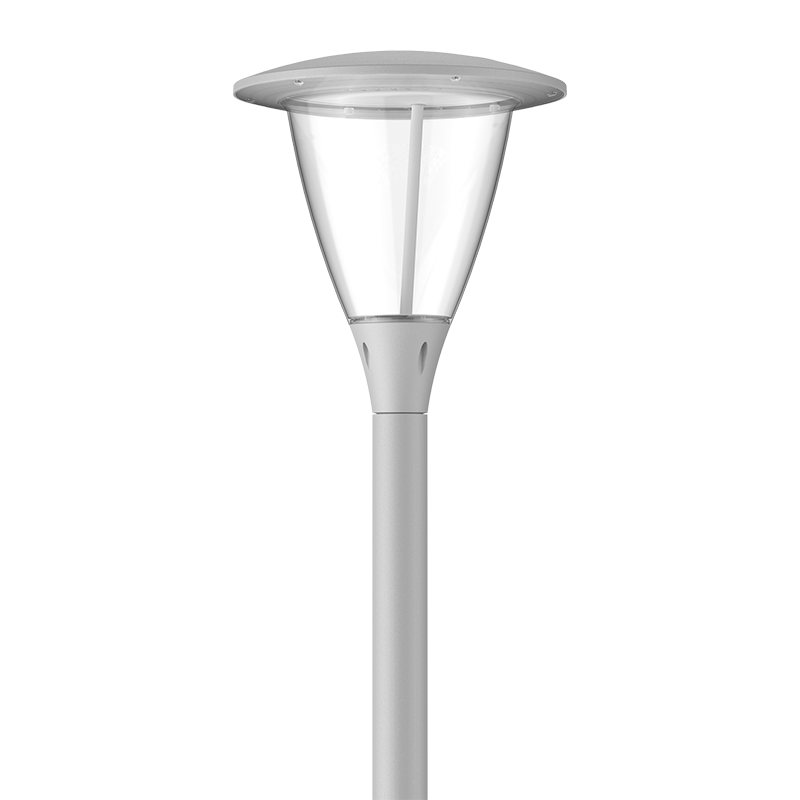
By contrast, quality wired LED garden lights operate across a far wider output range. A compact pathway bollard might deliver 500 to 800 lumens; a garden spotlight or floodlight can reach 1,500 to 5,000 lumens or more — sufficient to illuminate large trees, facades, or wide garden areas with genuine visual impact. The PODA LED Garden Light range, for example, is engineered to deliver stable, rated lumen output throughout its service life, without the seasonal variation that characterizes solar products.
| Product Category | Typical Lumen Output | Consistency | Suitable For |
|---|---|---|---|
| Budget solar garden light | 10 – 50 lm | Highly variable | Decorative accent only |
| Mid-range solar garden light | 50 – 200 lm | Variable by season | Pathway marking, soft accent |
| Premium solar garden light | 200 – 600 lm | Moderate (weather-dependent) | Pathway, low-level feature lighting |
| Wired LED garden light (compact) | 500 – 1,000 lm | Fully consistent year-round | Pathway, bollard, low feature lighting |
| Wired LED garden spotlight | 1,000 – 3,000 lm | Fully consistent year-round | Tree uplighting, facade, area lighting |
| Wired LED garden floodlight | 3,000 – 10,000+ lm | Fully consistent year-round | Security, large area, commercial garden |
| Lumen ranges are typical market averages; actual output varies by specific product. Source: Lighting Facts Product Database; IES illuminance recommendations for outdoor residential lighting | |||
Reliability and Consistency: The Solar Light's Fundamental Weakness
The single greatest limitation of solar outdoor lighting is its inherent dependency on solar energy availability — a factor entirely outside the user's control. This dependency creates several reliability challenges that compound over time.
Seasonal Performance Variation
In the northern hemisphere, a solar garden light installed at latitude 52 degrees (London, Amsterdam, Warsaw) receives approximately 8 to 9 hours of usable solar irradiance per day in June but only 1.5 to 2 hours in December (Source: European Commission, PVGIS Solar Radiation Database). The same light that performs well through summer may produce only 20 to 30% of its rated output through winter months, precisely when longer nights create the greatest demand for effective garden lighting.
Weather-Dependent Performance
Consecutive overcast days drain battery reserves progressively. A solar garden light with a battery capacity designed for one full night of operation at rated output has no reserve for multiple consecutive cloudy days. Users in climates with frequent cloud cover — northern Europe, Pacific Northwest North America, monsoon-affected regions of Asia — consistently report that solar garden lights perform poorly for months at a time, often producing dim, flickering output from depleted batteries.
Battery Degradation Over Time
Rechargeable batteries degrade with every charge-discharge cycle. Lithium-ion batteries, the most common chemistry in solar garden lights, typically retain 80% of original capacity after 300 to 500 full cycles — equating to less than two years of daily operation before noticeable performance reduction occurs (Source: Battery University, BU-808, "How to Prolong Lithium-based Batteries," Cadex Electronics). After three to five years, most solar garden lights operate at a fraction of their original brightness due to battery degradation, even if the LED chip itself remains in good condition.
PV Panel Soiling and Shading
Dust, bird droppings, leaf debris, and algae accumulation on the PV panel surface reduce charging efficiency. Studies on residential solar installations have found that panel soiling can reduce energy yield by 5 to 35% depending on environment and cleaning frequency (Source: National Renewable Energy Laboratory, "Soiling of Photovoltaic Modules," NREL Technical Report TP-5200-62785). For small solar garden light panels that are rarely cleaned, this effect is proportionally significant. Partial shading from adjacent plants or overhanging branches during even part of the day can reduce charging by 50% or more due to the series-circuit characteristics of PV cells.
Installation: Solar Wins on Simplicity, LED Wins on Permanence
Installation complexity is the area where solar outdoor lights hold their clearest advantage over wired LED alternatives — and it is a genuine advantage that explains much of their consumer popularity.
Solar Light Installation
Most solar garden lights require no electrical knowledge, no cable trenching, no conduit, and no connection to the mains supply. They are typically installed by pushing a ground spike into the soil, positioning the light for optimal sun exposure, and the system begins operating that evening. This simplicity makes solar lights accessible to renters, casual gardeners, and those installing temporary or seasonal lighting without professional assistance. Total installation time for a set of solar pathway lights: 15 to 30 minutes.
Wired LED Garden Light Installation
Installing mains-connected LED garden lights properly requires cable trenching (typically 450 mm deep for garden cable in most jurisdictions), appropriate waterproof conduit or armored cable, weatherproof junction boxes, connection to an outdoor-rated circuit breaker with RCD protection, and in many regions, inspection by a qualified electrician. This adds cost and complexity that solar installations avoid entirely.
However, once installed, a wired system requires no ongoing maintenance of power components, no seasonal repositioning for sun angle optimization, and no battery replacements. The installation cost is a one-time investment that is amortized across a service life of 15 to 25 years or more for quality fixtures — a very different economic picture from a solar system requiring battery replacement every 2 to 4 years.
Low-voltage (12V DC) LED garden lighting systems offer a middle ground: they require cable runs from a central transformer but do not require the same cable depth or RCD protection as mains-voltage systems, and in many regions can be installed without a licensed electrician. These systems deliver the consistency and output of wired LED lighting with significantly simpler installation than full mains-voltage approaches.
Lifespan and Total Cost of Ownership
When evaluated over a realistic ownership period of 10 to 20 years, the total cost of ownership comparison between solar and wired LED garden lighting typically favors wired LED — particularly at mid-to-high quality levels.
| Cost Factor | Solar Outdoor Light | Wired LED Garden Light |
|---|---|---|
| Initial fixture cost | Lower to moderate | Moderate to higher |
| Installation cost | Minimal (DIY) | Moderate to significant (cable, electrician) |
| Ongoing electricity cost | None | Low (LED is highly efficient) |
| Battery replacement (per unit) | Every 2 – 4 years | None required |
| Fixture replacement frequency | Every 3 – 7 years (typical) | Every 15 – 25 years (quality fixture) |
| Maintenance requirement | Panel cleaning, battery replacement | Minimal (periodic inspection) |
| Performance degradation over time | Significant (battery aging) | Gradual lumen depreciation only |
| Illustrative comparison; actual costs vary by product quality, location, and local electricity tariffs | ||
The U.S. Department of Energy has documented that quality LED outdoor fixtures used in permanent installations deliver lifecycle costs 40 to 60% lower than alternatives when replacement labor and energy costs are factored in over a 20-year period (Source: U.S. DOE, "Energy Savings Forecast of Solid-State Lighting in General Illumination Applications," 2016). While this comparison was made against older technologies, the principle applies equally to the solar-versus-wired LED comparison: frequent replacement and maintenance costs for solar systems erode their apparent upfront cost advantage significantly over time.
Light Quality: Color Rendering, Color Temperature, and Control
Beyond raw brightness, the quality of the light itself matters for garden aesthetics, plant health, and human visual comfort.
Color Rendering Index (CRI)
CRI measures how accurately a light source renders the true colors of objects compared to natural daylight (CRI 100). For garden lighting — where the colors of plants, stone, water, and architectural features are significant aesthetic elements — a CRI of 80 or above is recommended, with CRI 90+ preferred for premium landscape lighting. Most quality wired LED garden lights specify and reliably deliver CRI 80 to 95. Budget solar garden lights frequently omit CRI specifications entirely, and when measured, often perform in the CRI 60 to 75 range — producing a noticeably flat, color-washed appearance that diminishes the visual appeal of garden features.
Color Temperature Consistency
Wired LED garden lights are available across a full range of color temperatures — from warm white (2700K to 3000K, preferred for residential gardens for its flattering, comfortable quality) through neutral white (4000K) to cool white (5000K to 6500K, more suitable for security or commercial applications). Consistent color temperature across a multi-fixture installation creates visual harmony. Solar garden lights are less consistent in color temperature across batches and brands, making it harder to achieve a cohesive look when mixing products from different production runs.
Dimming and Smart Control
Quality wired LED garden lights are compatible with dimming systems, motion sensors, astronomical timers, and smart home integration platforms — enabling sophisticated lighting scenes that enhance garden ambiance while reducing energy consumption. Some solar lights include basic motion-activated brightening, but the control options available to wired LED systems are far more extensive. Smart LED garden lighting systems that adjust color temperature and brightness automatically based on time of night, season, or occupancy are increasingly available and represent a significant experiential upgrade over the fixed-output behavior of most solar alternatives.
Environmental Impact: A More Nuanced Comparison Than It Appears
Solar lights are widely perceived as the environmentally superior option because they use free renewable energy. The reality is more nuanced and depends significantly on the timeframe and full lifecycle considered.
The Battery Problem
The lithium-ion batteries in solar garden lights require mining of lithium, cobalt, and manganese — processes with significant environmental and social impact. A solar garden light that requires battery replacement every 2 to 3 years generates approximately 5 to 7 battery disposal events over a 15-year period, each involving a small lithium battery that should be recycled through specialized facilities but frequently ends up in general waste. A quality wired LED garden light operating for 20 years generates zero battery waste.
Grid Electricity and Renewable Energy
In countries where grid electricity is increasingly sourced from renewable generation, the environmental advantage of solar over grid-connected LED narrows significantly. In markets such as Norway (98%+ renewable electricity), Sweden (83%+ renewable), or the United Kingdom (where renewable sources exceeded fossil fuels for the first time in 2020 and have continued to grow), the carbon footprint of grid-connected LED garden lighting is already approaching that of solar lighting, while delivering superior performance (Source: International Energy Agency, "Renewables 2023," IEA Publications).
Product Longevity as Environmental Metric
A wired LED garden light lasting 20 years with minimal component replacement represents a smaller total material and manufacturing footprint than replacing solar garden lights — fixtures, batteries, and PV panels — multiple times over the same period. Product longevity is a meaningful but frequently overlooked environmental metric in consumer purchasing decisions.
When Solar-Powered Outdoor Lights Are the Right Choice
Despite the overall performance advantage of wired LED garden lights, solar outdoor lights are genuinely the better choice in specific circumstances. Recognizing these situations prevents unnecessary installation complexity for applications where solar works well.
- Off-grid locations: Garden areas, allotments, rural driveways, or outbuildings where running mains cable is not practical or cost-effective — solar is the obvious solution where no grid connection exists
- Rental properties: Tenants who cannot make permanent electrical installations can use solar garden lights without landlord permission or professional installation
- Temporary or seasonal use: Event lighting, seasonal decorative displays, or temporary pathway marking where a removable, no-installation solution is required
- Supplemental low-level accent lighting: Adding gentle ambient lighting to a garden that already has adequate primary wired lighting — solar stake lights around a flower bed, for example — where the modest output is fully sufficient for the decorative intent
- High-sunlight, low-demand applications: In climates with reliable year-round sun (Mediterranean, Middle East, tropical regions) and applications requiring only modest output, well-specified solar lights can perform consistently enough to be a practical choice
- Conservation areas and dark-sky locations: Where minimizing light output is a design requirement rather than a limitation, low-output solar lights are entirely appropriate
When Wired LED Garden Lights Are the Right Choice
Wired LED garden lights are the definitive choice whenever the application demands consistent, predictable, and controllable illumination over a long service life.
- Primary garden lighting: Main pathway lighting, driveway lighting, and garden area illumination where reliable output every night — regardless of weather — is required
- Security lighting: Applications requiring guaranteed operation and motion-triggered high brightness are not reliably achievable with solar systems that may have depleted batteries after cloudy periods
- Feature and landscape lighting: Uplighting trees, illuminating water features, highlighting architectural elements — where output consistency and CRI quality determine whether the visual effect is achieved
- Commercial and hospitality gardens: Hotels, restaurants, retail environments, and communal residential gardens where consistent, professional-quality lighting is a business requirement
- High-latitude and four-season climates: Regions with short winter days and extended periods of cloud cover where solar performance degrades most severely in winter — exactly when garden lighting is used longest
- Long-term investment mindset: Property owners planning to remain for 10 or more years who want to install once and benefit from consistent, high-quality lighting across the full period
For all of these scenarios, a professionally specified and installed LED Garden Light from PODA offers the reliability, output quality, and longevity that solar alternatives cannot match. PODA's LED garden light range covers the full spectrum of residential and commercial outdoor lighting requirements, with published technical specifications, appropriate IP ratings for outdoor installation, and the build quality needed to achieve rated lifespans in real-world garden environments.
Side-by-Side Comparison: Solar vs. Wired LED Garden Lights
| Comparison Factor | Solar Outdoor Light | Wired LED Garden Light | Winner |
|---|---|---|---|
| Brightness (lumens) | 10 – 600 lm (most products) | 500 – 10,000+ lm | Wired LED |
| Output consistency | Variable (weather/season) | Constant year-round | Wired LED |
| Installation effort | Very easy (DIY, minutes) | Requires cable and expertise | Solar |
| Running cost | None (solar powered) | Low electricity cost | Solar |
| Fixture lifespan | 3 – 7 years (battery limits) | 15 – 25+ years | Wired LED |
| Maintenance | Battery + panel cleaning | Minimal | Wired LED |
| CRI / light quality | Often unspecified (60 – 75 typical) | CRI 80 – 95 (specified) | Wired LED |
| Color temperature control | Fixed, limited options | Wide range, dimmable | Wired LED |
| Smart control compatibility | Limited (basic motion only) | Full smart home integration | Wired LED |
| Off-grid capability | Yes (no mains needed) | No (requires mains supply) | Solar |
| Battery waste | Multiple replacements over life | None | Wired LED |
| Total cost over 15 years | Moderate (replacements + batteries) | Lower (one installation, low running cost) | Wired LED |
| Comparison based on quality mid-range products in each category under temperate northern hemisphere climate conditions | |||
The Verdict: Matching the Right Technology to Your Situation
Choose solar outdoor lights if: you need a quick, installation-free solution for locations without mains access, you are renting and cannot make permanent electrical modifications, you want low-cost supplemental accent lighting in a sunny climate, or your application genuinely only requires modest output for decorative purposes.
Choose wired LED garden lights if: you want reliable, consistent illumination every night regardless of weather or season, your application requires meaningful light output for safety or visual impact, you are making a permanent garden investment and want a 15-to-25-year solution, or you want the flexibility of dimming, smart control, and color temperature selection.
For the majority of permanent garden lighting projects where performance, reliability, and long-term value are the priorities, a quality LED Garden Light is the superior choice — not because solar technology is without merit, but because the physics of solar energy harvesting and battery storage create fundamental limitations that wired LED systems simply do not face. The right solution for your garden depends on your specific needs — but if consistent, high-quality light is what you are after, wired LED delivers it more reliably than any solar alternative currently available.
Previous Post
Which is better: high-pressure sodium lamps or LED Garden Lightings?
Next Post
How long is the lifespan of LED garden lights?
Related Products

Our Products
Keep In Touch
export@polaryang.cn
+86-574-65167530
Xue'ao Qiangjiao Town, Ninghai County, Ningbo, Zhejiang, China
Contact Us
Copyright © Ninghai Poda Electrical Appliance Co., Ltd. Rights Reserved.
Wholesale LED Lighting Manufacturer
OEM Solar Lighting Factory
