 English
 Español
+86-13777012108
(WhatsApp/WeChat)
What is the working principle of LED garden lights?
With the growing popularity of green and environmentally friendly concepts, LED garden lights have become the preferred choice for modern landscape lighting and home garden decoration. They not only provide beautiful lighting effects but also enjoy widespread favor due to their energy-saving and long-lasting characteristics.
Content
Core Technology Analysis: The Working Basis of LED Lighting
To understand the working principle of LED garden lights, it's essential to first understand LED (Light Emitting Diode) technology itself.
Light Emission Principle: The core of an LED is a chip made of semiconductor materials. When current passes through a PN junction, electrons and holes recombine in the PN junction, releasing energy in the form of photons, thus emitting light. This process is called electroluminescence.
High Efficiency and Energy Saving: Unlike traditional incandescent lamps that emit light by heating a filament (resulting in significant heat loss), LEDs directly convert electrical energy into light energy with extremely high conversion efficiency, thus significantly reducing energy consumption.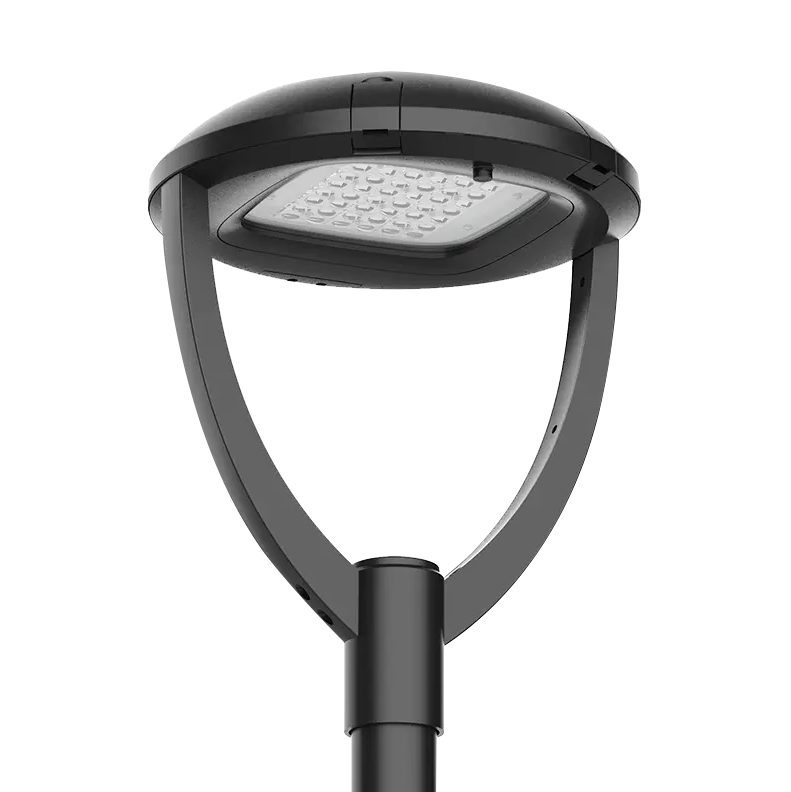
System Composition and Workflow of LED Garden Lights
A typical LED garden light system consists of the following key components working together to ensure efficient and reliable lighting:
- LED Light Source Module: This is the core light-emitting part of the lamp, composed of LED chips. Its primary function is to efficiently convert electrical energy into light energy, determining the light quality, brightness, and color of the lamp. It is a key component for achieving electroluminescence and energy saving.
- Driver/Controller: This component is the "brain" and "voltage regulator" of the lamp. It is responsible for converting the input power (whether AC from the mains or DC from a battery) into the stable and precise voltage and current required by the LED chips. It typically employs constant current drive technology to ensure the stability and lifespan of the LED lamp.
- Battery/Solar Panel: This is the power supply and energy storage system for LED garden lights. Especially for popular solar-powered LED garden lights, the solar panel (photovoltaic panel) is responsible for absorbing light energy during the day and converting it into electrical energy; while the energy storage battery (such as a lithium battery) is responsible for storing this electrical energy for nighttime use.
- Lamp Housing and Lens: These are the structural and optical components of the lamp. The lamp housing primarily protects the delicate internal electronic components from the outdoor lighting environment and ensures good heat dissipation and waterproof/dustproof ratings. The lens is used to achieve precise light distribution, controlling the angle and range of light projection.
1. Power Supply System: Wired and Wireless (Solar)
LED garden lights typically have two power supply methods:
- Maintenance (Wired): Suitable for large-scale or high-brightness landscape lighting. Alternating current (AC) is rectified, stepped down, and constant current processed by the driver power supply to stably supply the LED modules.
- Solar Power (Wireless): This is currently the mainstream trend for home garden lights.
- Daytime: Solar panels (photovoltaic panels) absorb sunlight and convert light energy into electrical energy.
- Energy Storage: Electrical energy is transferred to energy storage batteries (such as lithium batteries or nickel-metal hydride batteries) for storage.
- Nighttime: The light control switch (controller) senses the ambient darkness and automatically connects the circuit, allowing the electrical energy stored in the battery to be converted into light energy through the LED beads, illuminating the garden.
- Daytime: Solar panels (photovoltaic panels) absorb sunlight and convert light energy into electrical energy.
2. Drive and Control: Ensuring Stable Operation
LEDs require very precise current. Excessive current will quickly burn out the LED beads, while insufficient current will affect brightness. Therefore, constant current drive is the core of stable operation for LED garden lights.
Function: The driver ensures that the current flowing through the LED remains at a stable and safe level, thus guaranteeing the brightness and lifespan of the LED light fixture.
Intelligent Features: Modern garden light controllers also integrate intelligent functions such as timing, brightness adjustment, and even human body sensing.
Summary of Advantages of LED Garden Lights
- Extra-long lifespan: Thanks to LED technology and a stable driver power supply, their lifespan is often dozens of times longer than traditional lights, greatly reducing maintenance costs.
- Extremely low energy consumption: High luminous efficiency means they use less electricity. For solar-powered LED garden lights, this translates to shorter charging times and longer lighting times.
- Environmentally friendly and safe: Free from harmful substances such as mercury and lead, and operating at low voltage, they are highly safe and ideal for outdoor courtyard lighting.
The energy-saving and long-life characteristics of LED garden lights stem from their efficient light-emitting diode technology and precise constant current drive system. Solar-powered LED garden lights, in particular, achieve energy self-sufficiency through photovoltaic technology, representing an inevitable trend in future landscape lighting.
Previous Post
Which Outdoor Floodlights Are the Best?
Next Post
What are LED High Bay Lights?
Related Products

Our Products
Keep In Touch
export@polaryang.cn
+86-574-65167530
Xue'ao Qiangjiao Town, Ninghai County, Ningbo, Zhejiang, China
Contact Us
Copyright © Ninghai Poda Electrical Appliance Co., Ltd. Rights Reserved.
Wholesale LED Lighting Manufacturer
OEM Solar Lighting Factory
