 English
 Español
+86-13777012108
(WhatsApp/WeChat)
Should you choose solar-powered or wired garden lights?
When choosing outdoor lighting solutions, whether to choose solar-powered or wired LED garden lights mainly depends on your installation environment and usage needs. If your garden is already finished and it's inconvenient to dig trenches and lay wires, solar-powered LED garden lights are the preferred choice, offering the advantages of zero electricity costs and easy installation; if you prioritize brightness stability, durability, and more sophisticated smart control features, wired LED garden lights are more advantageous.
Content
Solar LED Garden Lights: The Epitome of Low Carbon and Convenience
Solar LED garden lights have become extremely popular in recent years, primarily due to their high degree of autonomy.
- Zero electricity cost operation: Using monocrystalline or polycrystalline silicon solar panels on top, they absorb ultraviolet light during the day, converting it into electrical energy and storing it in a lithium battery. They automatically light up at night.
- Easy installation: No professional electrician is needed, no digging up the lawn for wiring, just plug and play. This is very convenient for homeowners who want to add LED garden lights later.
- High safety factor: Because they use low-voltage DC power, there's no need to worry about safety hazards caused by leakage in rainy weather or pets biting the cables.
Wired LED Garden Lights: The Cornerstone of Stability and Quality
Despite advancements in solar technology, traditional wired LED garden lights still dominate in professional landscape design.
- Worry-free brightness: Wired lights are not affected by the weather; even during continuous rainy days, they can maintain high lumen output. For path lights or spotlights that need to serve as main lighting, the wired solution is more reliable.
- Longer lifespan: Wired LED garden lights eliminate the easily aging lithium battery components and use a constant current driver power supply, with an overall lifespan typically reaching 5-10 years.
- Smart connectivity: Wired systems are easier to integrate into smart home gateways, enabling timed switching via mobile apps, group control, and RGB color changes, creating a more layered atmosphere.
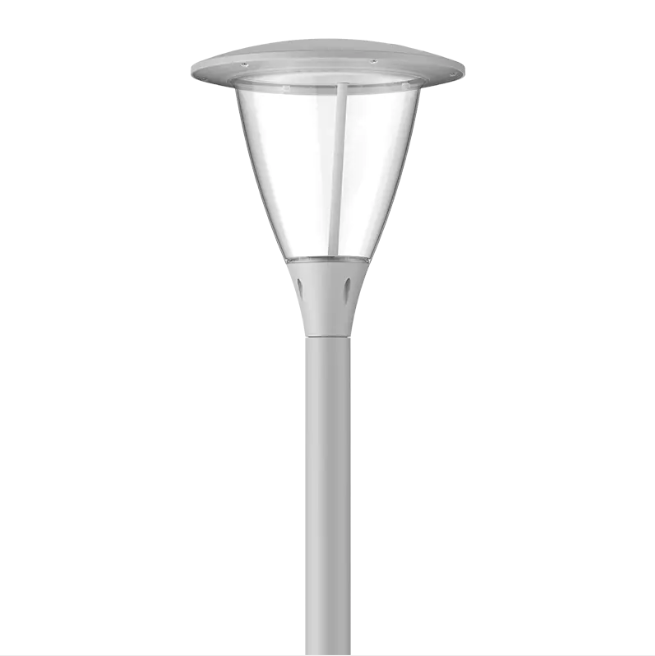
Core Parameter Comparison: What to Look for When Buying?
Regardless of which power supply method you choose, the standards for evaluating a high-quality LED garden light are universal:
- Waterproof rating: Outdoor environments are harsh, so it is recommended to choose IP65 or higher to ensure that it does not leak or short circuit even under heavy rain.
- Color Rendering Index (Ra): High-quality LED garden lights should have a color rendering index greater than 80, which allows them to reproduce the truest colors of plants when illuminated, rather than appearing washed out.
- Housing Material: Prioritize die-cast aluminum material, which has better heat dissipation than plastic and is more corrosion-resistant and less prone to fading or deterioration.
Manufacturer's Suggestions: How to achieve optimal layout?
As a professional LED garden light manufacturer, we recommend adopting a "zoned management" strategy when designing garden lighting:
- Landscape Decoration Areas: Such as flower beds and potted plants, use solar-powered LED garden lights for flexible placement and adjustment.
- Main Pathways and Entrances: For safety reasons, it is recommended to install wired LED garden lights to ensure that the path home is always brightly lit.
- Water Features and Swimming Pools: It is essential to choose professional wired lighting fixtures with a high waterproof rating and install a residual current device (RCD) for safety.
"Solar-powered" lights excel in convenience and energy saving, while "wired" lights excel in stability and professionalism. When purchasing LED garden lights, clarify your budget and wiring conditions, and choose die-cast aluminum products from reputable manufacturers to ensure your garden shines beautifully at night.
Previous Post
How to Choose Outdoor Floodlights?
Next Post
What's the difference between outdoor floodlights and spotlights?
Related Products

Our Products
Keep In Touch
export@polaryang.cn
+86-574-65167530
Xue'ao Qiangjiao Town, Ninghai County, Ningbo, Zhejiang, China
Contact Us
Copyright © Ninghai Poda Electrical Appliance Co., Ltd. Rights Reserved.
Wholesale LED Lighting Manufacturer
OEM Solar Lighting Factory
